
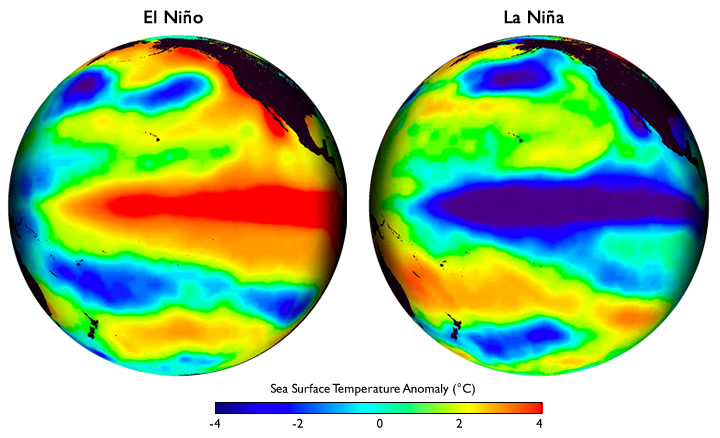


Have you ever noticed how weather forecasts seem to be getting weirder every passing year? You might have found yourself shivering on a strangely cold mid-summer day, or stepping outside in January to find unnaturally mild, autumn-like warmth that makes you question what season it actually is. Maybe you have watched the news in disbelief as one region suffers through months of scorching, endless drought while another continent thousands of miles away gets inundated by relentless torrential rains and severe flooding. While it is easy to write off these bizarre seasonal shifts as mere bad luck or chaotic weather, there is a massive planetary heat engine operating behind the scenes that governs these global swings. That engine is the El Niño–Southern Oscillation, widely known as ENSO, and its alternating phases, El Niño and La Niña, are the primary drivers behind the world’s most dramatic weather anomalies.
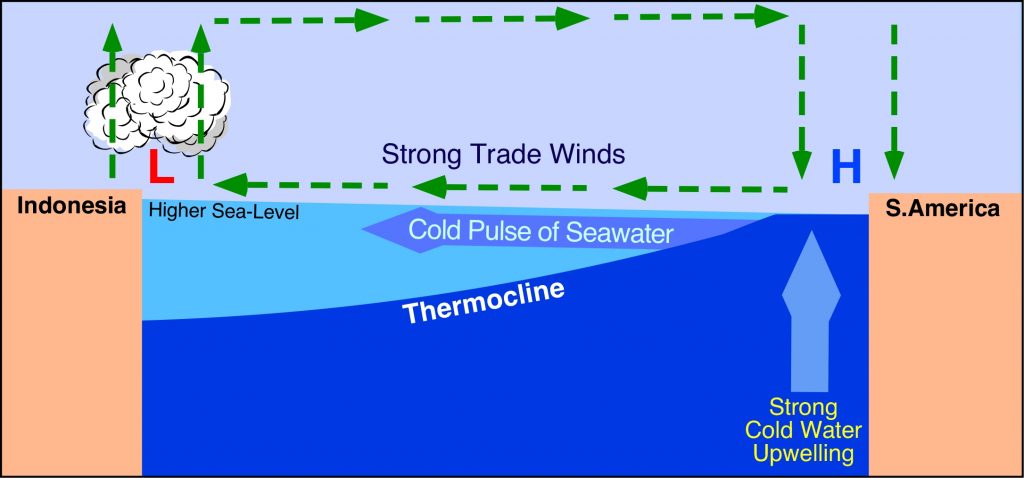
At its core, the Earth’s climate system relies on a continuous balance between the ocean and the atmosphere, with the ocean storing huge amounts of solar energy and releasing it into the air over time. This is due to water being worse at absorbing and radiating heat than land. Nowhere is this dynamic more powerful than across the vast expanse of the tropical Pacific Ocean. Under normal, non-El Niño conditions, strong trade winds blow consistently from east to west along the equator due to the Earth’s rotation. These winds act like a gigantic broom, pushing warm surface waters off the South American coast toward the western Pacific basin near Indonesia and northern Australia. As warm surface water accumulates in the west, cold and nutrient-rich deep ocean water rises to replace it off the South American coast near Peru and Ecuador. This process is known as coastal upwelling. This contrast creates a sharp ocean surface temperature gradient across the Pacific, which in turn drives a closed loop of atmospheric circulation called the Walker Circulation, where warm air rises over the western Pacific Ocean warm pool, travels east high in the atmosphere, and sinks over the cool waters of the eastern Pacific (Wang, 2018).
https://www.weather.gov/source/zhu/ZHU_Training_Page/tropical_stuff/enso/images/neutral.jpg
The entire system stays locked in place through an atmospheric-oceanic feedback loop known as the Bjerknes feedback mechanism. This principle shows that the ocean and atmosphere are locked in a perpetual dance where changes in sea surface temperatures modify wind patterns, which then feed back into ocean temperature changes (Wang, 2018). When trade winds push warm surface water west, the atmospheric temperature contrast between the warm west and cool east sharpens, which causes the trade winds to blow even harder. This tightly coupled physical feedback keeps the global climate engine stable until subtle physical nudges push the system into one of two extreme states: El Niño or La Niña.
When the atmospheric equilibrium breaks down, the Pacific swings into an El Niño phase. During El Niño, the equatorial trade winds weaken or even reverse to blow from west to east. Without strong winds to hold the warm water pool over Indonesia, a massive pulse of warm water surges back eastward across the Pacific Ocean toward South America. As this warm water spreads across thousands of miles, coastal upwelling off South America is suppressed. The thermocline, that is the boundary separating warm surface waters from cold deep ocean water, deepens dramatically in the east, and the center of tropical storm activity shifts into the central and eastern Pacific Ocean (Wang, 2018). This shift is not uniform across every occurrence, and climate scientists have identified distinct “flavors” of ENSO diversity, distinguishing canonical Eastern Pacific events from Central Pacific “El Niño Modoki” events, each triggering unique global atmospheric reactions (Capotondi et al., 2015).
https://live-production.wcms.abc-cdn.net.au/cba2140454f0d1a786a6ad450cee7ec6?src
On the opposite side of the spectrum lies La Niña, the cold counterpart of the oscillation. During a La Niña phase, normal trade winds blow with unusual intensity. These exaggerated easterly trade winds pile an extra-deep layer of warm ocean water into the western Pacific, while pulling immense volumes of freezing, nutrient-dense deep water up along the coast of South America. The eastern tropical Pacific experiences sea surface temperatures well below historical averages, steepening the thermocline and shifting heavy tropical rainfall even further west over Australia, Indonesia, and Southeast Asia (Wang, 2018).
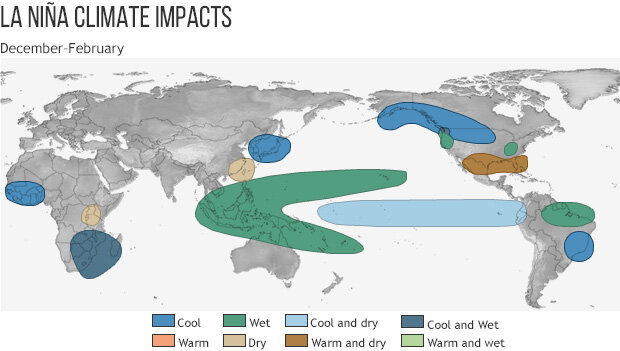
https://www.climate.gov/sites/default/files/styles/full_width_620_original_image/public/2023-03/Nina_globalimpacts_620.jpg?itok=otx54QK1
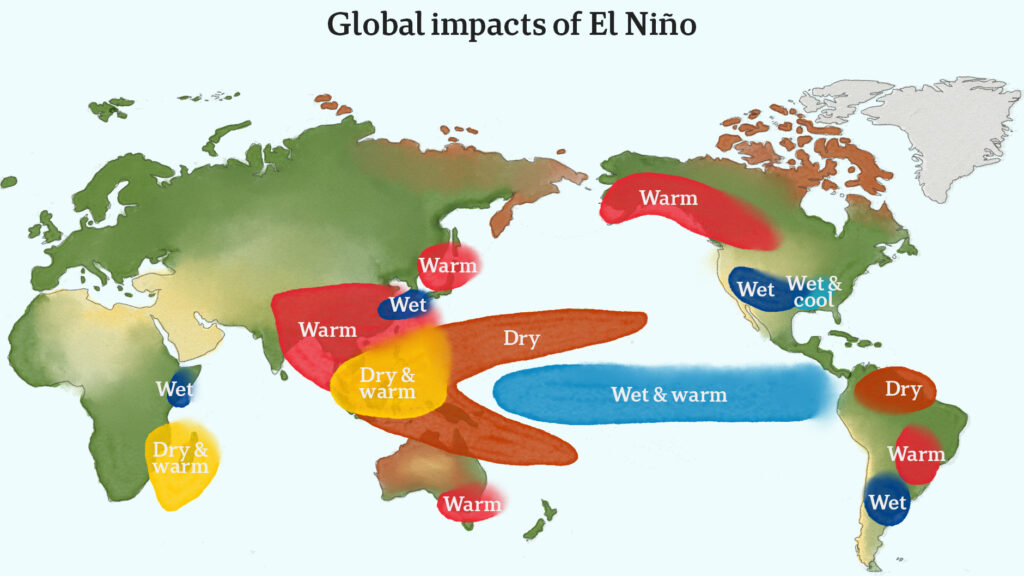
You might wonder how sea surface temperature changes in the middle of the equatorial Pacific can directly influence rainfall in Europe, snowstorms in North America, or droughts in Southern Africa. The answer lies in planetary-scale wave patterns called atmospheric teleconnections (Power & Delage, 2018). When tropical thunderstorm activity shifts position across the Pacific Ocean, it injects vast amounts of latent heat into the upper atmosphere. This sudden relocation of atmospheric heating places massive obstacles in the path of planetary airflow, and bends and alters the high-altitude jet streams that guide weather systems around the world.
Because jet streams determine where winter storm tracks travel, where cold arctic air drops southward, and where warm tropical air builds up, bending these air rivers generates cascading weather anomalies across continents. During an El Niño winter, for example, the Pacific jet stream stretches out and moves further south, bringing heavy rainfall, landslips, and storms across the southern United States while causing warmer, milder conditions across northern regions. Across the globe in Southeast Asia and Australia, the departure of tropical rainstorms triggers severe heatwaves, agricultural failure, and devastating bushfire seasons (Power & Delage, 2018). Conversely, when La Niña takes over, the jet stream shifts northward, bringing colder and wetter winters to the Pacific Northwest and northern United States, while exposing the southern United States and parts of South America to lingering droughts and crop loss (Power & Delage, 2018).
These oceanic and atmospheric shifts ripple deep into global ecosystems and human society. When El Niño shuts down coastal upwelling off South America, marine food webs collapse within weeks. Without cold, nutrient-dense waters rising to the surface, phytoplankton populations plummet, leading to starving anchovy populations, crashing fisheries, and widespread marine ecosystem distress (Holbrook et al., 2020). On land, agricultural regions dependent on reliable seasonal monsoons face unpredictable shifts. Major grain-producing areas encounter sudden drought or unseasonable flooding, disrupting global supply chains, triggering sharp food price inflation, and creating widespread economic insecurity (Holbrook et al., 2020).
Understanding ENSO becomes even more urgent when viewed through the lens of modern climate change. You have likely noticed that our recent weather does not just feel different from year to year. It feels warmer overall, punctuated by unnerving extremes like record-breaking winter heatwaves or sudden summer cold snaps. As human activities emit greenhouse gases into the atmosphere, the top layers of the world’s oceans absorb the vast majority of that excess heat. This upper-ocean warming increases ocean thermal stratification, making surface temperatures far more sensitive to changing trade winds (Cai et al., 2021).
Recent scientific modeling indicates that global warming is amplifying the frequency and intensity of extreme El Niño and La Niña events (Cai et al., 2021). Because baseline ocean temperatures are now significantly higher than they were a century ago, even a mild El Niño phase can push tropical ocean waters past the temperature thresholds needed to trigger violent atmospheric storms. This background ocean warming creates the strange weather experiences we see today: winter warm spells where snow vanishes overnight, prolonged summer rain and cold spells caused by stalled jet streams, and rapid transitions from severe drought to sudden deluge. Climate projections indicate that as global temperatures continue to rise, atmospheric teleconnections will intensify and shift eastward, making seasonal weather swings faster, harder to predict, and far more disruptive to communities worldwide (Cai et al., 2021).
Ultimately, the weather anomalies you observe in your daily life are not isolated incidents. The unexpected heatwave in midwinter, the unseasonable chill during a summer month, or the sudden intense storm season are all linked back to the continuous ocean-atmosphere dance taking place in the tropical Pacific Ocean. As human-driven climate change continues to heat our oceans and alter fundamental atmospheric baselines, decoding the physics of El Niño and La Niña becomes essential for anticipating, adapting to, and surviving the increasingly unpredictable climatic conditions of our modern world.
References:
- Cai, W., Santoso, A., Collins, M., Dewitte, B., Karamperidou, C., Kug, J.-S., Lengaigne, M., McPhaden, M. J., Stuecker, M. F., Taschetto, A. S., Timmermann, A., Wu, L., Yeh, S.-W., Wang, G., Ng, B., Jia, F., Yang, Y., Ying, J., Zheng, X.-T., … Geng, T. (2021). Changing El Niño–Southern Oscillation in a warming climate. Nature Reviews Earth & Environment, 2(9), 628–644. https://doi.org/10.1038/s43017-021-00199-z
- Capotondi, A., Wittenberg, A. T., Newman, M., Di Lorenzo, E., Yu, J.-Y., Braconnot, P., Cole, J., Dewitte, B., Giese, B., Guilyardi, E., Jin, F.-F., Karnauskas, K., Kirtman, B., Lee, T., Schneider, N., Xue, Y., & Yeh, S.-W. (2015). Understanding ENSO Diversity. Bulletin of the American Meteorological Society, 96(6), 921–938. https://doi.org/10.1175/bams-d-13-00117.1
- Holbrook, N. J., Claar, D. C., Hobday, A. J., McInnes, K. L., Oliver, E. C. J., Gupta, A. S., Widlansky, M. J., & Zhang, X. (2020). ENSO‐Driven Ocean Extremes and Their Ecosystem Impacts. Geophysical Monograph Series, 409– https://doi.org/10.1002/9781119548164.ch18
- Power, S. B., & Delage, F. P. D. (2018). El Niño–Southern Oscillation and Associated Climatic Conditions around the World during the Latter Half of the Twenty-First Century. Journal of Climate, 31(15), 6189–6207. https://doi.org/10.1175/jcli-d-18-0138.1
- Wang, C. (2018). A review of ENSO theories. National Science Review, 5(6), 813–825. https://doi.org/10.1093/nsr/nwy104
Leave a Reply