

Our universe is made up of the cosmic web, a large-scale structure made up of interconnected filaments and sheets of matter [1].
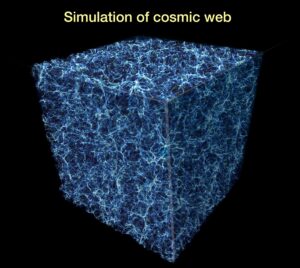
Photo Credits: NASA. Filaments and sheets of matter create an interconnected web that forms the large-scale structure of the universe. https://science.nasa.gov/mission/hubble/science/science-highlights/mapping-the-cosmic-web/
This image shows the cosmic web on a cubic scale. The blue filaments represent the matter (mostly dark matter, which is invisible to the eye), and the dark regions in between represent the cosmic voids [1].
The cosmic web is the largest known structure, but astrophysicists begin the organization of the universe at the stellar level. Stars are organized into galaxies. Galaxies then form galaxy groups; groups form galaxy clusters and superclusters; these make sheets, and finally, walls and filaments at the largest scale. These walls and filaments are separated by large voids, in the web-like mesh known as the “cosmic web.”
The largest known matter structure in the universe is the galaxy filament. Galaxy filaments are threadlike structures formed of walls that contain galaxy superclusters. They form the boundaries of voids.
Galaxy filaments are usually between 50 to 80 megaparsecs in length, however the largest confirmed galaxy filament, the Quipu, is 400 megaparsecs. The Hercules–Corona Borealis Great Wall, a proposed, unconfirmed, galaxy filament would be the largest structure in the known universe, measuring an unimaginable 3 gigaparsecs (3000 megaparsecs) in length [2].
To provide context on the size of these cosmological objects, one parsec is approximately 3.26 light-years or 30.9 trillion kilometers [3]. The light-year is a measure of the distance light travels in one year. In one second, light travels 300,000 kilometers, and in one year it travels an astronomical 9.46 trillion kilometers [4]. For context, our Solar System is about 3.17 light-years or 0.97 parsecs in diameter (Note: parsecs are used to measure the distances between objects in our solar system and those outside our solar system; that is why our Solar System’s diameter is less than one parsec) [3][5]. Our Solar System lives in the larger Milky Way Galaxy, which is approximately 100,000 light-years, or 30,660 parsecs in diameter. The alleged Great Wall filament would be almost 100,000 times the size of our galaxy, and 3 trillion times larger than our solar system!
Cosmic voids exist between these massive galaxy filaments. These abysses of empty space are enormous, between 10 to 100 megaparsecs in diameter. Although the definition of a cosmic void is still disputed, most researchers agree that cosmic voids are under-dense regions of space containing very few or no galaxies at all. This means that they have very low Mean Cosmic Densities (MCD) [6].
MCD refers to the idea of measuring the average density of matter in a region of space. This is found by counting the galaxies in a region, adding up their masses, and dividing that by the volume containing them (there is more complexity involved in this, however it is too time-consuming to discuss all the limitations). This value is important in understanding the critical density. The critical density is the minimum density needed to halt the universe’s expansion. This value relies on the Hubble Constant, a value that describes the universe’s rate of expansion. For a Hubble Constant value of H = 71 km/s/Mpc (Unit: kilometers per second per megaparsec), the critical density is roughly 10^-26 kg/m³. This number is tiny! It gives us an understanding of the emptiness of the universe. It is equivalent to 4 or 5 hydrogen atoms in a cubic meter of space. Comparably, it’s equivalent to the density of a single grain of sand alone within the volume of the Earth [7]. Critical density is calculated with the following formula:
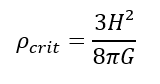
The critical density is proportional to the value of the Hubble Constant squared. This means that a larger density is needed to halt the expansion of the universe.
Cosmic voids are vastly under-dense. When the concept of critical density is applied to these vast regions of space, it is clear that they would be expanding at a faster rate than the rest of the universe. They coalesce with other voids and continue to comprise most of the universe.
The existence of cosmic voids is important to astrophysics and the study of the universe for various reasons; one being the (still disputed) existence of dark matter and dark energy. It may seem that cosmic voids are empty pockets of nothingness, but they are home to large concentrations of dark energy. Dark energy is a crucial component of the Big Bang Theory, and is integral to understanding the expansion of the universe [6].
Furthermore, voids exhibit properties of effective antigravity. The density of the matter at the edges of the void gradually pulls particles out of the void, creating a gravitational hill at the centre of the structure. The expansion of the void contributes to this antigravitational effect [6].
Additionally, a large mystery of cosmic expansion and the age of the universe may be understood by cosmic voids. The aforementioned Hubble Constant, named after the astronomer Edwin Hubble who discovered cosmic expansion in 1929, is an important factor in understanding how our universe expands. The relationship between how far away an object is and how quickly it recedes from us is known as the Hubble Constant. Multiplying this value by the distance yields the velocity of the expansion. For years, the age of the universe was estimated to be between 9.7 billion years and 19.5 billion years. However, the observations by the Hubble Space Telescope narrowed that region down to a single number: 13.8 billion years. This value has an accuracy of almost one percent, providing an incredibly precise prediction of the universe’s age.
The Hubble Space Telescope measured expansion by observing two celestial phenomena in particular: Cepheid variable stars and Type 1a supernovae that have known brightnesses. These phenomena are distant from Earth, but since they have known brightnesses, scientists are able to measure how far they are. To do this, they compare the observed brightness to the actual brightness. NASA gives the analogy of observing the headlights of a car in the dark―if you know how bright the headlights should be, their distance can be calculated from how bright they appear.
The other way to determine the Hubble Constant is through analysis of the cosmic microwave background (CMB) of the universe. The CMB is the first radiation to travel through space following the Big Bang, and it is still detectable as a faint background radiation glow.
Both methods allow for the calculation of the Hubble Constant, but curiously they both result in different answers. Space telescope measurements find a Hubble Constant, or expansion rate for the universe, of around 70-76 kilometers per second per megaparsec (which gives an age for the universe of about 13.8 billion years). Conversely, measurements derived from studying the CMB provide a Hubble Constant of about 67-68 kilometers per second per megaparsec. At first thought to be measurement error, it has since been determined to be a fundamental problem in our understanding of physics. Scientists call this discrepancy the “Hubble Tension.” The Hubble Tension is an active topic of debate, and no conclusion has been reached as of yet, making it one of cosmology’s largest mysteries of the present day [8].
One proposed solution to the Hubble Tension relates to cosmic voids. Our galaxy sits in the Local Group, a galaxy group that lies adjacent to the Local Void. This region of space is confirmed to exist, meaning the regions near our neighbourhood are under-dense. However, it is proposed that our galaxy, the Milky Way, resides in the KBC Void, also known as the Local Hole. The Local Hole is a supposed region of space that is roughly spherical, and approximately 2 billion light-years, or 600 megaparsecs, in diameter. Its existence is disputed, and there is still more research that needs to be conducted to understand our place in the universe―however the Local Hole could account for the discrepancy in the Hubble Constant.
As previously mentioned, objects are repelled from voids, and galaxies inside voids would experience a gravitational pull from outside of it. Since our galaxy resides in a void, it would experience a larger gravitational pull from the outside, resulting in a larger local value for the Hubble Constant. This is consistent with the value that the Hubble Space Telescope found [9].
There are many other theories pertaining to the Hubble Tension, however there isn’t a generally accepted solution yet. The more we learn about our universe, the more we understand how much we do not know.
The next time you look at the night sky, consider that we live on a planet floating in an enormous sea of a galaxy, floating in the nothingness of a void. Let it be a reminder to our smallness in the vast ocean of the universe, and let it guide you into a new understanding of our feebleness as humans.
References
[1] “Mapping the cosmic web – NASA Science,” NASA Science, https://science.nasa.gov/mission/hubble/science/science-highlights/mapping-the-cosmic-web/ (accessed Sep. 28, 2026).
[2] “Large-scale Structure of the Universe,” Wikipedia, https://en.wikipedia.org/wiki/Large-scale_structure_of_the_universe#Cosmic_Web:_walls,_filaments,_nodes,_and_voids (accessed Sep. 28, 2026).
[3] “Parsec,” Wikipedia, https://en.wikipedia.org/wiki/Parsec (accessed Sep. 28, 2026).
[4] “What is a light-year? – NASA Science,” NASA Science, https://science.nasa.gov/exoplanets/what-is-a-light-year/ (accessed Sep. 28, 2026).
[5] Unistellar, “How Big is the Solar System?,” UNISTELLAR, https://www.unistellar.com/blog/how-big-is-the-solar-system/ (accessed Sep. 28, 2026).
[6] “Void (astronomy),” Wikipedia, https://en.wikipedia.org/wiki/Void_(astronomy) (accessed Sep. 28, 2026).
[7] “Mean Cosmic Density,” Teach Astronomy – Mean Cosmic Density, https://www.teachastronomy.com/textbook/Cosmology/Mean-Cosmic-Density/ (accessed Sep. 28, 2026).
[8] “Hubble Constant and Tension – NASA Science,” NASA Science, https://science.nasa.gov/mission/hubble/science/science-behind-the-discoveries/hubble-constant-and-tension/ (accessed Sep. 28, 2026).
[9] “Local Hole,” Wikipedia, https://en.wikipedia.org/wiki/Local_Hole (accessed Sep. 28, 2026).
Leave a Reply