


3D printing is defined as a process for creating three-dimensional objects by adding layers of two-dimensional cross sections on top of each other [1]. Deriving its name from its similarities to ink-based printers, it has applications in everything from rapid prototyping to jewelry-making. Its origins, however, may not be as well-known.
3D printing was first invented in May 1981 by Hideo Kodama at the Nagoya Municipal Industrial Research Institute. He was the first to publish literature about the layer-by-layer method of fabrication that is essential to 3D printing. His technology was similar to stereolithography, as it involved photopolymers that used light to harden material. Despite being the first to publish in this field, Kodama did not fulfill the patent application and so was never granted the patent. Another group, Alain Le Méhauté, Olivier de Witte, and Jean Claude André, began a patent application for stereolithography technology but abandoned it due to ‘lack of business perspective’ [2].
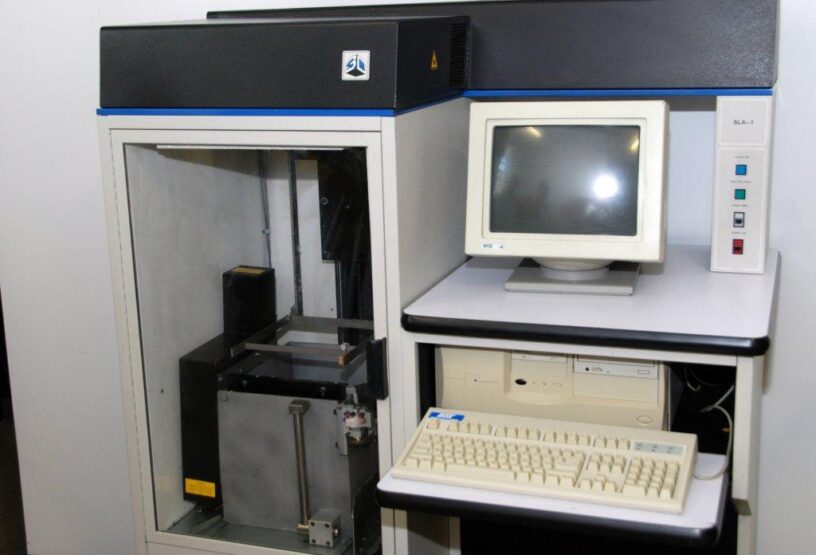
The first to patent 3D printing technology was Charles Hull in 1986, who also invented the first stereolithography apparatus (SLA) machine and co-founded 3D Systems Corporation. He introduced the STL file format, digital slicing, and the first commercial 3D printer, the SLA-1, in 1987 [2].
Others would also go on to file patents for 3D printing technology. Carl Deckard at the University of Texas filed a patent in 1987 for Selective Laser Sintering (SLS), which used a laser to solidify powder polymers. This technology was issued to DTM, Inc. and later acquired by 3D Systems Corporation. Soon after, Lisa and Scott Crump filed a patent for fused deposition modelling (FDM) that used plastic filament and Hans Langer founded EOS in 1989 [3].
The 3D printers around this time were large and mainly intended for industrial prototyping. The first 3D printers intended for small-scale manufacturing were created by Solidscape, founded by Royden Sanders in 1993. These machines made wax molds that could be used to cast objects out of other materials and were popular with jewelry makers [2].
The small-scale FDM printers that are popular today started appearing in the 2000s. In 2008, the RepRap (‘replicating rapid prototyper’) concept founded by Adrian Bowyer led to the creation of ‘Darwin’. It was intended to be a self-producing machine: a machine that could create most of its own parts. RepRap was an open source project focused on spreading low-cost 3D printing worldwide and gained popularity with people editing the designs [2].
By 2019, there was over 170 3D printer system manufacturers across the world including Formlabs, Stratasys, and Prusa, among others [3]. This technology has demonstrated applications in everything from bioprinting to architecture. Today, there is no doubt that people all over the world will continue to find new ways to innovate with 3D printing.
References:
Leave a Reply