
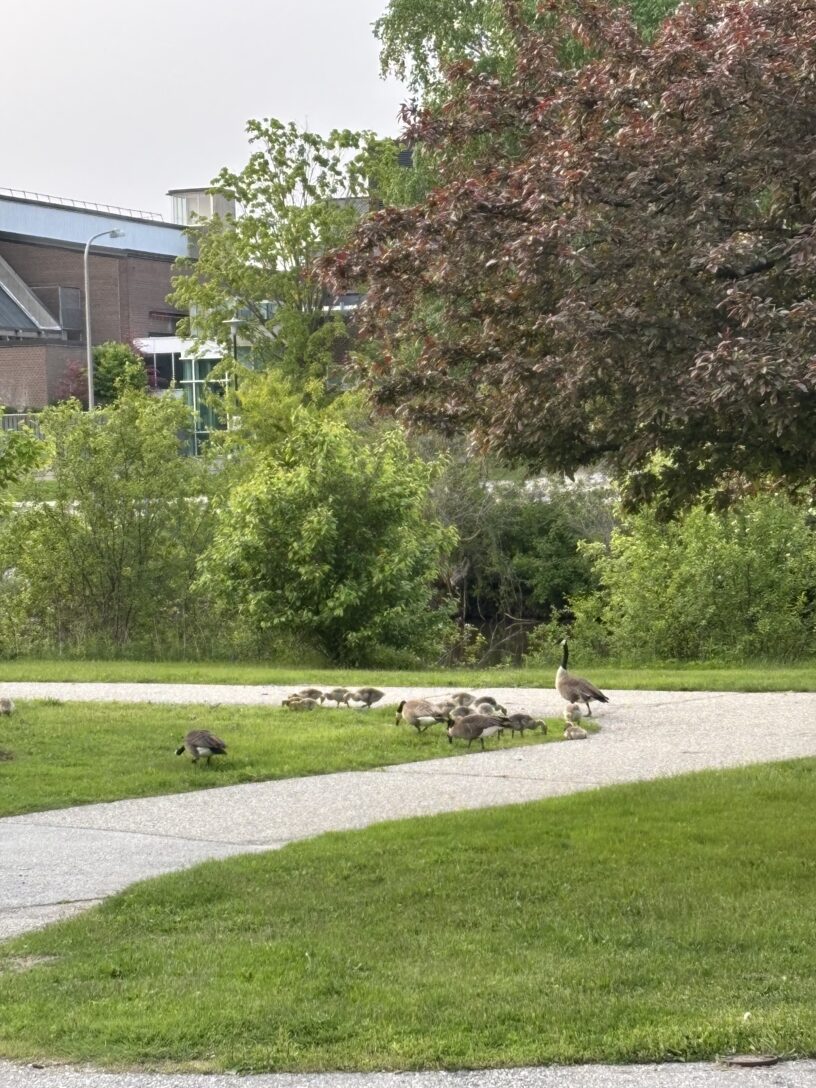



Ever since the term started, I’ve been bothering almost everyone I know on-campus (or in Waterloo/Kitchener) with one question: how are the geese? I am a MASSIVE goose lover (I love them sooooo much!!!! and I have way too many geese pictures from last year), but I know many people aren’t, and I can see why. They poop everywhere, the honking, the hissing, the chases… and the list goes on and on with reasons to hate the geese.
Though I am simultaneously a fan and hater of the geese, there is still so much I don’t know about them. Truthfully, before writing this article, I didn’t know why the geese are on our campus in the first place! And since I can’t be the only one with no idea why geese are blessing/punishing us with their presence, why are the geese…
Everywhere on campus?
This is the one question I’ve wanted answered ever since I came to Waterloo, and I finally took the time to search it up. For the last few decades, the geese (Canada geese) have undergone a great population growth due to human-induced changes to the landscape that favour the geese. Geese usually live in mild climates with abundant wetland and grassland habitats, and have few natural predators. Many have come to live in urban areas due to being safer from predators, safer from hunters (I’ll talk more about that later) and having more access to sources of food, not to mention that they’ve adapted to the changing urban environments [1]. When you think about it, our campus is a big open space with lots of grass and water, so it’s no surprise this is one of many places they would stay.
Some people might notice it’s almost like the geese never leave… even during winter (I’m sure some of you readers have noticed geese in the winter). While most geese migrate to warmer climates during the winter, some of them prefer to stay in one place all year long (i.e. our campus) [2]. And those that come back after the winter then find a mate, have babies, and stay on campus for a while to raise them. And then those babies grow up, also mate, and come back to campus to raise their own babies, and so on. (In other words, the geese come back because campus is, in a way, their ancestral home) [2].
Some people also probably noticed that even late at night, the geese are still walking about. It turns out that just like us students during exam season… they don’t sleep! Geese prefer to take many short naps throughout the day, often adding up to about 2 to 5 hours of sleep. They also sleep anywhere, either on grass or water [3].
Secretly one-legged?
Rest assured, they have 2 legs. This question is here just to highlight the fact that geese can often be seen standing on one leg, and that’s something they do while sleeping/napping to help preserve body heat [3].
Pooping everywhere?
This question is only here for humour, and therefore deserves a short, humorous answer: they weren’t potty trained.
Always with their children?
They’re parents, duh!!!!! On a serious note, geese watch over their children to make sure they are safe, to show them where to find the best food, and eventually to show them how to fly. You might also notice with some flocks a massive ratio of adult geese to goslings: parents sometimes bring their children together in “creches” so the parents can communally watch after all the children [4].
SOOOOOO fast (especially when chasing us)?
Geese are notoriously highly territorial, especially during breeding season (I once saw a video of a goose (not Canada goose, but still) attacking a horse… you can imagine how that ended for the goose). When trying to chase away interlopers, geese (with outstretched necks) wave their heads from side to side and up and down, honking loudly, and if the interlopers don’t leave, they fly after them, biting with their beaks and flapping their wings like boxing punches. I know from experience because when I got attacked by a goose, it felt like it was trying to break my skull by hitting its wings on my head. And though I thought I could outrun the goose, it’s highly unlikely I’d escape an angry bird flying at (maybe) 30 to 40 mph (much faster than any human) [5].
Though they’re definitely not the fastest birds ever, geese (in general) are widely admired for their flight endurance, being able to fly hundreds of miles in a single nonstop flight, as well as at very high altitudes (like the bar-headed geese, which have been observed to fly at nearly 30,000 feet, i.e. high enough to cross the Himalayas!) [5].
Untrackable?
Well actually, they’re not! Recently, Anirudh Dabas, a CS student, built Waddleloo, a platform that allows students to report goose sightings. The sightings are displayed on a map with verified sightings, hotspots and nesting areas. You can use the map to determine routes through campus for safe travel. I haven’t checked it out myself, but it looks cool [6]! An older website, GooseWatch, very similar to Waddleloo, also exists to allow people on campus to monitor goose hotspots.
On the news?
Don’t be surprised, but there are some online news articles of our very own geese! If you search online, Waddleloo has garnered quite a lot of attention, but I also found two CBC Stories from 2025, one of a goose entering a Laurier building and walking up to a Starbucks, and another of an aggressive nesting goose trapping Laurier students inside their house for a week. In the article, they report another story, from 2015, of geese harassing a turkey to death, as well as another 2015 story about the ‘Spawn of Satan’… (as you can guess, a very aggressive goose) [7]. I found another article on CTV News of geese getting relocated from Waterloo Park due to complaints (in that article, I found out that the city of Waterloo spent $40,000 cleaning goose poop in 2024!) [8]
Protected by law?
The geese are protected under the Migratory Birds Convention Act (MBCA), which arose from the Migratory Birds Convention of 1916 between Canada and the US [1]. Back then, many migratory birds were in severe decline (and some species, like our Canada geese, were facing extinction) due to unregulated hunting and plumage trade [9], prompting the US and Canada to protect these birds through the law. Thanks to the MBCA, geese populations managed to drastically rise (ironically, to the point where the geese now exceed population objectives in several parts of the country) [1].
Some illegal acts against geese include destroying their nests; harassing, killing or capturing them (without some form of permission: geese are game birds and can be hunted during established hunting seasons); feeding them, or even honking your car horn at them while they’re crossing the streets (for all you drivers reading this article, geese have the right of way!)
Not going to ruin your Summer 2026?
Because you’re not gonna let them! There are so many things to enjoy on-campus and off-campus this term (including EngPlay!… GO TO ENGPLAY!), friends to hang out with and good movies out in cinemas right now! You’re also (hopefully) going to give the geese lots of space this summer when you’re wandering around. Though I’m not on campus this term, and have no idea what kind of problems the geese may have caused, I’m hoping that everyone is enjoying their summer and will continue to enjoy it… until Finals arrive. What I also hope is that you’ll let the geese make your summer more memorable. One of the main reasons I remember Spring 2025 so fondly are the geese:
- Goslings are SOOO CUUUUUUUUUUUTE (and there are so many too! I was at St. Jerome’s that summer, and we had a lot of geese families near SJ2 and HS).
- Watching a goose defecate right in front of me (and on top of that, it defecated right where my foot was about to land; thankfully I stopped before my shoe landed on a biohazard).
- Seeing geese cross the street (the first time was a family crossing the street exactly like a kindergarten class would, with the parents in the front and back ushering the kids forward – a picture of that scene has been used in some of our previous articles – and the second time was at night, coming back from a movie with a friend, and crossing the street back to campus alongside a goose).
- Seeing the goslings grow up SOOOO FAST!!!!
- And the most memorable (of course): getting attacked by a goose (I was just minding my business walking to class and got hissed at behind me, then heard quick steps and wing flapping coming towards me, so I knew I was screwed despite starting to run away.)
Let’s all agree Waterloo would not be Waterloo without its angry chickens.
References:
(1) Government of Canada. (2025). Canada geese: frequently asked questions. https://www.canada.ca/en/environment-climate-change/services/migratory-bird-conservation/managing-conflicts/frequently-asked-questions.html
(2) Mosley, M. (2026, February 13). Holy crap: UW’s goose infestation. Daily UW. https://www.dailyuw.com/article/holy-crap-uw-s-goose-infestation-20260213
(3) BirdFact. (2022). Where do geese sleep? https://www.birdfact.com/articles/where-do-geese-sleep
(4) Love Canada Geese. (2005). Canada goose gangs. http://www.about.lovecanadageese.com/gang.html
(5) Dive Bomb Industries. (2025). How fast can geese fly: Facts about their speed and endurance. https://www.divebombindustries.com/blogs/news/how-fast-can-geese-fly-facts-about-their-speed-and-endurance
(6) Punithan, M. (2026, April 8). New website helps you duck, duck, goose on campus. Cheriton School of Computer Science, University of Waterloo. https://uwaterloo.ca/computer-science/news/new-website-help-you-duck-duck-goose-campus
(7) Lucs, I. (2026, March 31). Canada goose gets trapped inside a Laurier campus building and chaos ensues. CBC News. https://www.cbc.ca/news/canada/kitchener-waterloo/canada-goose-laurier-starbucks-video-tiktok-students-scream-9.7148458
(8) Knox, S. (2025, June 10). Canada geese in Waterloo Park relocated to bird sanctuary. CTV News. https://www.ctvnews.ca/kitchener/article/canada-geese-in-waterloo-park-relocated-to-bird-sanctuary/
(9) Ducks Unlimited Canada. (2016). Migratory milestones. https://www.ducks.ca/stories/partnerships/migratory-milestones/
Leave a Reply