


Credit to Globe and Mail
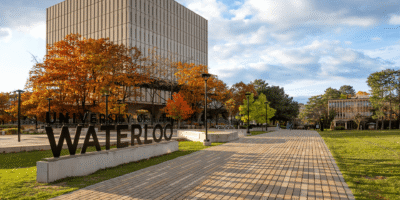
On the morning of Sunday, September 20, over 1,000 people gathered in Waterloo Park to run several kilometers each. The run was done in Terry Fox’s legacy, with runners encouraged to donate to the cause of cancer research. In all, 1108 people donated $90,410 to the Fox Foundation – smashing their goal of $72,700.
The run was one of over 500 organized across Canada under Terry Fox’s name – all with the goal of raising money for innovative cancer research. The Terry Fox Foundation has supported 859 cancer researchers across 269 funded projects. They explore innovative therapies ranging from precision treatment (dynamically targeting specific cancers with tailored treatments) to AI-backed ultrasound technology (which will hopefully be able to get much faster results on the effectiveness of chemotherapy).
Why is Terry Fox called a ‘Hero’?
Terry Fox was 19 years old when he developed osteosarcoma (the most common bone cancer often starting near the knees) and was prescribed above-knee amputation – ending his time as an athlete as he had known it. During his cancer treatment, two things stood out to him.
The first was the value of cancer research. At age 19, he was given chemotherapy and a 50% chance at survival. Grim. But he was told that just two years earlier, his chance of survival would have been just 15%. This statistic stuck with him, and he later cited it as a reason he chose novel cancer research as his mission.
The second was the paltry funding that cancer research received. He was well exposed to this lack of investment during his time in the cancer wards. The tiny cancer research budget was so stark that it infuriated him, and ignited a passion that would later fuel one of the greatest feats of human perseverance on record.
What set Terry Fox apart from most was how he handled these setbacks. After 16 months of brutal chemotherapy, most would be ready to rest, recover and celebrate. Not Terry:
I soon realized that that would only be half my quest, for as I went through the 16 months of the physically and emotionally draining ordeal of chemotherapy, I was rudely awakened by the feelings that surrounded and coursed through the cancer clinic. There were faces with the brave smiles, and the ones who had given up smiling. There were feelings of hopeful denial, and the feelings of despair. My quest would not be a selfish one. I could not leave knowing these faces and feelings would still exist, even though I would be set free from mine. Somewhere the hurting must stop … and I was determined to take myself to the limit for this cause. – Terry Fox, 1979, in a letter to the Canadian Cancer Society asking for support
Galvanized by his time in the hospital, Fox was determined to make a difference. After 3 years playing wheelchair basketball (for which he was named an All-Star player in 1980), Fox began what I can only describe as a string of inhuman feats.
It begins with the planning for his run. At the time, Dick Traum was being celebrated for running the New York Marathon with a prosthetic leg. This inspired Terry to try to run a marathon. Every single day. For almost a year straight (although he tragically never achieved his full goal). This would be akin to learning about a world record and planning to break it 1000-fold. I can only describe this as an inhuman feat of optimism.
Once he knew he was serious, he told his family about his plan – and was met with discouragement (his mother later felt guilty). Despite this he continued, recruiting his friend Doug Alward (who cooked and drove behind him), and securing sponsors to provide the van, leg and shoes. The legendary Marathon of Hope thus began. In the first days of his run, he was met with a snowstorm, heavy rains, and gale-force winds. Undiscouraged, he continued without breaks for 143 days (bar a single two-day pause to time a fundraiser with Canada Day). Far worse for him was the disheartening lack of support and acknowledgment in the early days of the run (His first large donation would be just before leaving Newfoundland). He often fought with his companion Doug, and they were barely on speaking terms by the time they reached Nova Scotia. Later upon entering Quebec he was met with a harsh language barrier, and aggressive drivers who would force him off the road. This was an inhuman feat of perseverance.
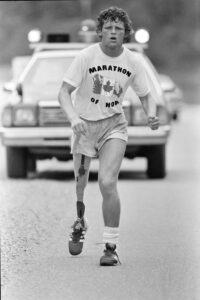
Everything about this run is impressive, but the physical and athletic accomplishments are no laughing matter either. He ran 143 consecutive daily marathons, stopping only once to time his arrival into Ottawa. He did all this running on an old prosthetic: he had to hop-step the entire way to let the springs settle, and throughout he had blisters, bruises and intense pain which would become tolerable only after 20 minutes of running. Every day, he began running at 4:30 AM and would sometimes go all the way to 7 PM. Near the end, he faced advanced lung cancer on top of all these challenges. I can only describe his run as a herculean athletic feat.
All the while, Terry took every opportunity he could to raise money for cancer, speaking to businessmen, civilians, press, other athletes and more. During his run, he had raised $1.7 million ($6 million dollars today) for cancer research, and others have raised far more in his name. By the time he reached Ontario, he was considered a national hero. Tragically, he died a martyr to advanced lung cancer, ending his run in Thunder Bay.
We finally have an answer to our question: Terry Fox was a hero because he had an altruistic dedication to his cause so intense that he pulled off a preternatural feat of optimism, tenacity and endurance. Furthermore, he brought incredible awareness and funding to a lifesaving cause, saving countless people from one of the world’s worst type of diseases.
Why do we still do Terry Fox runs today?
In 1937, the Canadian Cancer Society had an annual budget of $14,000 ($325,000 today). Today, the organization has a budget of $130,000,000, of which nearly $50,000,000 is spent on lifesaving research. The increase is simply the most easily seen impact of the awareness Terry Fox raised on cancer. Furthermore, the Fox organization has separately raised a cumulative $1,000,000,000 over the years. It is hard to say exactly how much of this would have gone to cancer research without Terry Fox’s work, but it is undeniable that he has saved thousands of lives from cancer, and the research continues to save lives even today.
Another notable result is that Terry Fox reframed conversations about disability. He frequently refused to be labelled as “disabled,” saying that his circumstances instead made life more “challenging yet rewarding,” and has made lasting impacts on the perception of disability in Canadian society.
Whether it is done to pay homage to a great Canadian hero, or if it is done to inch cancer closer to its last malignancy – Terry Fox runs continue to embody a noble cause and are a wonderful addition to any community. Terry’s story is a lesson to us all about the tremendous value of determination, and of the power of a single citizen for positive change.
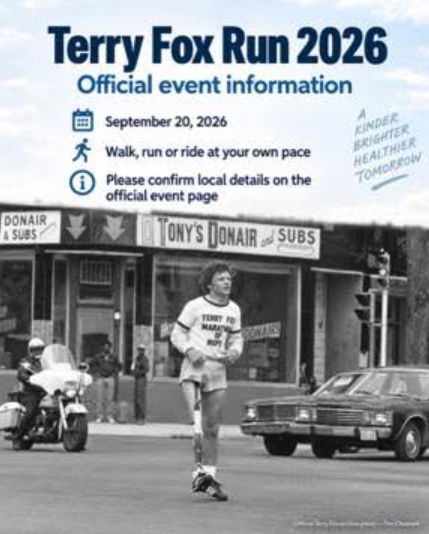
Donations can be made to https://terryfox.org/ or https://cancer.ca/, and next year’s run is on September 19th, 2027.
Leave a Reply