


Hello Waterloo! I hope everyone is having a wonderful Fall term so far!
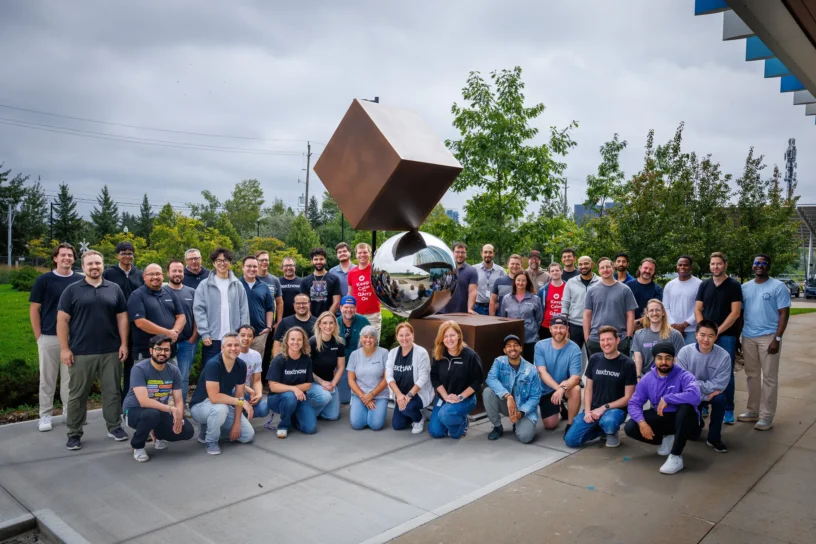
Continuing our “Highlighting Alumni Voices” series we started early this year (check out our interview with 3e8 Robotics in W26I1), I got the chance to interview the CEO and co-founder of TextNow, Derek Ting (CE ’10), whose company reached $1 billion dollars in cumulative revenue a few weeks ago!
Q: What is TextNow, and how does it stand out from other mobile providers?
Derek: TextNow is an app that you can download so you can get free phone service. There’s a couple of ways you can use it. One way you can use it is if you just want a second phone number, and you don’t want to pay for it, you can download our app and you can get a second local phone number. Another way people use it, like folks that don’t want to pay for phone service, is as their main phone number. You can install an eSIM on your phone and then use our app to text and call, and it has nationwide coverage and you can use it instead of paying for phone service. Talking and texting is free, and if you want to add data, we have affordable data plans you can add on. However, the eSIM is only available in the US, not available in Canada yet.
I think what’s unique about our service is you can flex up and down. You can get by with a free phone service most of the time, and when you need data, then you can pay. When you don’t need it, you can flex out at the free service. A lot of our customers have low or unstable income, so some weeks or some months they can pay and then certain weeks or months they can’t; with our flexible plans, we don’t want them to worry about their phone service being shut off if they can’t pay.
Q: What was the original spark behind TextNow, and how did the company grow into what it is today?
Derek: We actually just started by wanting to make our own co-op term. It was my last co-op term, and I didn’t want to go somewhere far away. I wanted to stay close to campus and do something fun. So we decided to spend one co-op term building apps, and TextNow was one of them. How TextNow came to be was that I just didn’t want to pay for text messaging; I thought it was a rip off. So then I decided to make an app that makes text messaging free. So at the very beginning, that’s all it was: an app that made text messaging free.
The “aha” moment was that we found out that 90% of our customers were using it to turn their iPod touches into phones because they didn’t have phone service. They were using the iPod touch to install our app to text, and that was kind of our “aha” moment that it wasn’t text messaging we needed to provide to them; it was actually phone service. That began our multi-decade obsession to figure out how we can make phone service free.
(Fun fact: It all started in a student apartment on King Street!)
Q: What does the $1B milestone represent for you personally, and for the company’s next chapter?
Derek: It’s been a long journey. We started from something really small, really simple, which was just to make our own co-op term and make enough money to pay rent (and pay for pizza). We originally did not have the ambition to make it this big, so reaching $1 billion… it’s just incredible to see how far we’ve come, having started so small, and it’s incredible to see if you just keep at things for a long time, have fun, how much progress you can make.
It’s inspiration for us to keep going because the journey isn’t done. There’s still a lot of things we want to do, a lot of new products we still want to build.
Q: On that note, what are the next steps or major objectives for TextNow as you continue scaling?
Derek: The biggest problem we’re currently working on is figuring out how to make mobile data free, not just talking and text.
Our big ambitious goal right now is we want 1 in 10 phone numbers in the US to be TextNow phone numbers. Our vision is that one day, when you go to a party and you talk to somebody, you’d be shocked if they’re paying for phone service. We want phone service to be ubiquitous and free, just like email.
Q: What were the toughest challenges in scaling TextNow from a startup to an international platform, and how did you navigate them?
Derek: It’s hard to pick one challenge. When businesses grow, a lot of problems just kind of happen at once. When you’re running the business day to day, you [have] got to deal with growing the team and installing leaders to lead the team. Every day, you’re solving a new problem, and the challenge is that you’re overwhelmed with problems, but you need to be able to sort through them, pick the most important problems and focus on each one at a time.
Q: Why is it important for you that TextNow stays independent?
Derek: We decided to take a different path from a lot of companies. A lot of companies raise a lot of capital, and burn through much of it early on before they figure out their business model. We started the company wanting to be ramen profitable* on day one, so that’s part of our DNA; our DNA is that we’re here not just to build products and build cool things, we’re also here to build a business.
It fits what we love doing, which is building businesses, building products, and for us, it’s more rewarding to build a business, it’s more rewarding to build a product than to build PowerPoint presentations. The reason we haven’t raised a bunch of money is because raising money is a lot of work, but you’re also building PowerPoint presentations and it’s not as fun, not as rewarding.
Another thing is that it is a blessing not taking investor money because it allows us to build things at our own pace and it allows us to take risks that we want to take and make mistakes, whereas some companies don’t have that luxury. When you innovate, when you build new things, a lot of things won’t work, which can be costly. And when you have investors, they may not have the patience when things don’t work. Being in charge of our own destiny means we can try as much as we want, as long as we need, as long as it takes to follow through on an idea that may not work the first few tries. So I think that is a blessing and we wouldn’t have it any other way.
Q: Any advice for Waterloo students/recent grads looking to start or continue building their own company?
Derek: My advice is pick something fun, pick something you’re interested in. Don’t pick something because it’s hot or it makes money. A lot of people do that; they design their business or their product based on what they think investors will fund, and I don’t think people should do that. I think people should do what’s interesting to them, do what is fun, because building a business is a grind and it takes a long time. You’ve got to enjoy what you’re doing to keep at it long enough to find success.
Équilibre Oblique
To mark the $1B milestone, TextNow unveiled a permanent sculpture by Phillipe Pallafray, Équilibre Oblique, in Waterloo’s Research and Technology Park (which I highly recommend checking out in person, it looks amazing!)
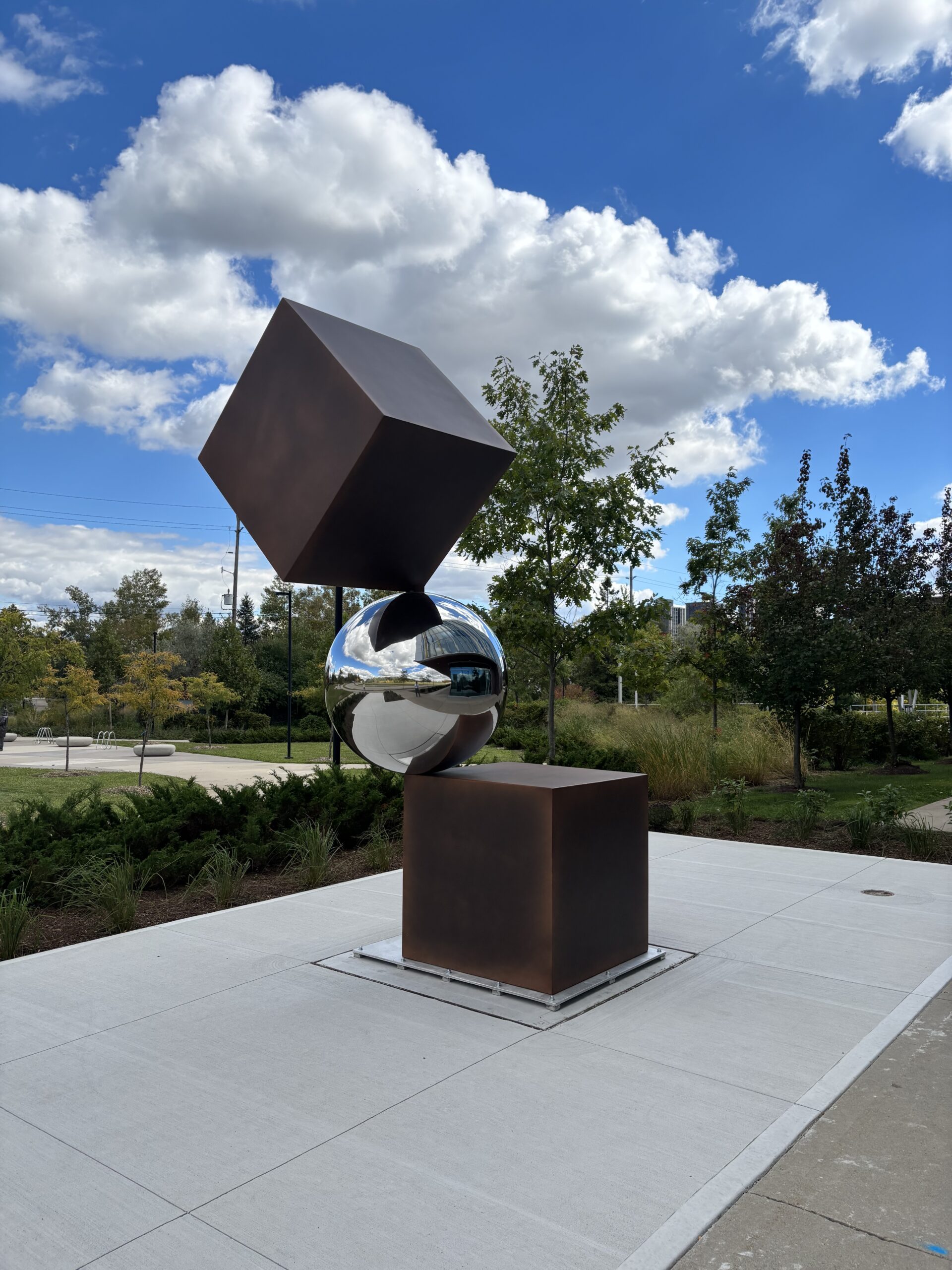
Photo Credits: Jeremy Bijoux! Check this sculpture out at Research and Technology! It’s just a brief walk from the ION station.
The sculpture is composed of 3 distinct forms representing the progression from ideas to startups to scaled companies, and is meant to reflect the entrepreneurial journey that has helped make Waterloo one of Canada’s most recognized technology hubs. The steel in the center acts as a mirror, designed to inspire other founders to see themselves in TextNow’s story.
When asked about the sculpture’s design and why the team chose a sculpture to mark the milestone, Mr. Ting explained:
“I think the sculpture represents that anything is possible if you just start small and you have fun while you do it. It reflects so you can see yourself through the ball, and that’s kind of like, the theme behind it: anyone can do it and you can see yourself doing it. Art is something that last forever, meanwhile an event is just one day, and then it’s gone. Installing something there [at the park], it lasts forever and it looks nice.”
Thank you so much to Derek Ting for his time, and Brianna Clyburn for arranging the interview! If you’re interested in learning more about TextNow and their services, check out their website: https://www.textnow.com!
Wishing everyone a relaxing Reading Week and good luck on midterms! WE WILL COOK!
If you are a student or alum who would like to be featured in The Iron Warrior, reach out to us at theironwarrior@gmail.com!
*Ramen profitable: a startup makes just enough revenue to cover the founders’ basic living expenses.
Leave a Reply