



There are many traditions that have held up our engineering community for a long time. Some are absurd and abstract, while others honour the engineers of our past. These traditions connect us with our alumni and keep us bound as a community. Here is a compendium of just a couple traditions; some newer, and some from the past that have been taken out or modified to fit the modern time.
The Mascot & Guardian Traditions
The Tool
Forged by the Ridge Tool Company in Elyria, Ohio, The Tool is a 60-inch, triple chrome-plated adjustable pipe wrench weighing over thirty pounds. Officially adopted in 1968 under the visionary leadership of Engineering Society (EngSoc) President Jim Pike, it was chosen over a competing proposal for a medieval broadsword.
This decision proved historically fitting when students triumphantly debuted the wrench by throwing it directly onto the University’s Board of Governors boardroom table. The heavy chrome left behind several permanent dents in the polished wood, and an indelible mark on campus culture.
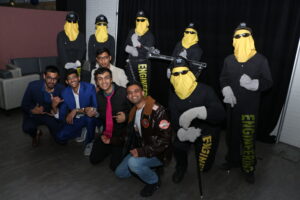
Since that chaotic introduction, The Tool has operated under a strict, unyielding “Golden Rule”: the wrench serves as a unifying symbol of institutional pride and can only be physically touched by those who wear an Iron Ring. To protect it from lower-year hands and rival universities, a highly secretive, elite group of students dressed in black-and-gold uniforms known as The Tool Bearers serve as its silent, stoic guardians.
Junior (The Mini-Tool)
Because undergraduate logistics require a mascot for routine student conferences, parades, and external events, a precisely scaled-down travel replica named “Junior” was later introduced. Unlike its monolithic older sibling, anyone, including first-years, is permitted to hold Junior. This tactical concession is designed to build student morale before they earn the right to touch the original.
Material Gear & Pride Culture
Coveralls (“Covvies”)
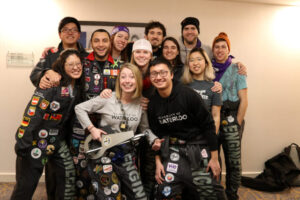
Purchased during the Society’s designated “Coverall Period” each term, these heavy-duty canvas suits act as a living, wearable scrapbook of a student’s undergraduate career. They are defined by three core pillars:
- Customizations & Color Codes: Covvies are colored by engineering discipline or orientation roles. While classic UW engineering students most commonly wear blue-gray, Orientation Week Media and Bigs wear custom colors for their respective teams. They are meticulously sewn with patches from anything you can think of.
- The Chop & Swap: A beloved community ritual where students trade chopped-off sleeves, legs, or pockets from their O-Week covvies or from other engineering schools’ suits to create a multi-colored patchwork.
- The Washing Taboo: An unwritten, absolute rule dictates that coveralls must never be machine-washed once customization begins. The compounding buildup of shop grease, structural dust, and spilled beverages is viewed as an authentic, hard-earned badge of labor.
Patch Culture Community: For students dedicated to custom patches and design, the community connects via the discord: https://discord.gg/xVs8tdzv8g
Leather Jackets
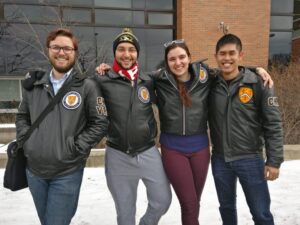
The custom-fitted black leather faculty jackets worn around campus feature the graduation year on the right sleeve, the department on the left sleeve, and “WATERLOO ENGINEERING” boldly emblazoned across the back.
They originated in the early 1960s as purple corduroy jackets with gold lettering. The distinct design was intentionally styled to signal to local drivers that a hitchhiking engineering student was stranded and could be trusted for a safe ride.
The Crest
Designed in 1968 by Veikko Kuronen, the geometric Waterloo Engineering emblem features six distinct geometric symbols representing the original six disciplines:
- The Gear: Mechanical Engineering, Mechatronics Engineering
- The Lightning Bolt: Electrical Engineering, Computer Engineering, Software Engineering, Mechatronics Engineering, Nanotechnology Engineering, Management Engineering
- The Test Tube: Chemical Engineering, Nanotechnology Engineering, Environmental Engineering
- The Transit: Civil Engineering, Environmental Engineering
- The Grey Background: Geological Engineering
- The Unifying Circle: Systems Design Engineering, Biomedical Engineering, Management Engineering

The Purple Monster
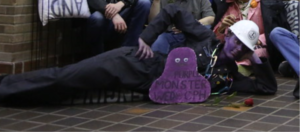
Every 16 months following an intense EngSoc executive election, the newly elected President undergoes a trial by ordeal. They are “kidnapped” by the society, dyed entirely purple from head-to-toe using gentian violet, and left chained to a solid concrete block in the Carl Pollock Hall (CPH) foyer. Passing undergraduate students use this window of confinement to cross-examine the new leader regarding future platforms, funding allocations, and faculty politics.
The Non-Existent Action Committee (NEAC)
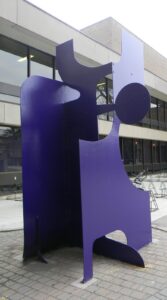
A mythical, shadowy student group used to explain anonymous, massive architectural campus pranks. Operating under the ironclad motto, “does nuthin’, saw nuthin’, heard nuthin'”, NEAC shields individuals from administrative liability. Historic operations credited to their guerrilla engineering include painting the giant orange Douglas Wright Engineering (DWE) sculpture to look exactly like Tony the Tiger and wrapping the entirety of the POETS student lounge in tinfoil.
The Charity Bus Push
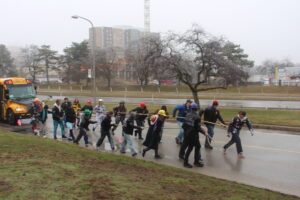
An annual community outreach event running continuously since 1977. Originally, dozens of students teamed up to physically haul a 40-foot-long Grand River Transit (GRT) city bus via thick ropes for roughly 6.5 kilometers through the streets of Waterloo to collect donations. Modern iterations have adapted the route to a loop around Ring Road, utilizing a school bus where community members can donate to ride along.
Governance Micro-Rituals
- The “Point of Order” Slam: Council representatives rhythmically and violently slam their fists against folding tables whenever a bureaucratic violation of parliamentary bylaws is successfully called out.
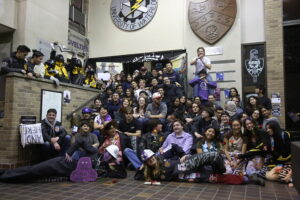
- The Executive Roast: An unregulated, raw cross-examination during the final meeting of the term (Council 5, which famously doubles as a potluck). General members are given free rein to grill the executive team on failed campaign promises, administrative missteps, and personal eccentricities.
EngPlay & TalEng
The society preserves its performing arts legacy through digital and stage archives. EngPlay is a student-run, hilariously satirical, engineering-themed theatrical production written, directed, and performed by engineering students every single term. Legendary runs (such as The Legend of Spartaloo or POETS: More Than a Lounge) are preserved on the EngSoc YouTube channel as cultural time capsules.
Dates this term for Lay All Your Eng on Me: July 17th and July 18th.
Time: 7:30PM, doors open at 7:00PM.
Location: ML Theatre of the Arts.
Tickets can be purchased online (https://bit.ly/S26Engplay), in E7 or CPH nearly every day, or in ML before the show.
Tickets bought in person cost $12.81 each!
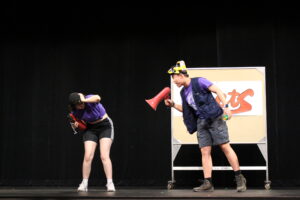
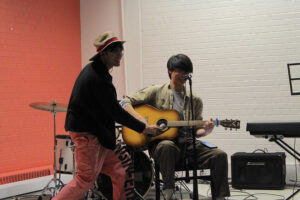
For those looking to showcase musical, comedic, or bizarre non-theatrical skills, TalEng serves as the official termly talent night, a crucial community booster offering a rare glimpse of artistic life piercing through brutal technical workloads.
Endangered, Sanitized, or Defunct Eras
As campus culture evolved, several historic traditions were retired or altered to meet modern safety, ethical, and legal standards.
| Era / Tradition | Original Format | Modern Status / Outcome |
| The GradComm “Slave Auction” | Lower-year students volunteered to be auctioned off to graduating fourth-years as “IRS Slaves” to cook breakfast and run erratic errands. | Defunct: Completely banned for ethical reasons; replaced by standardized, structured peer volunteering. |
| The “Wet” Orientation Week | Featured massive, licensed outdoor beer tents on campus, culminating in a giant Saturday night Toga Party. | Defunct: Ended by a 1978 LLBO crackdown and the 2003 elimination of Grade 13 (which lowered the freshman age to 18). Alcohol was permanently banned from O-Week by 2004. |
| Uncensored Chanting & Lady Godiva Hymns | Highly offensive, faculty-exclusionary chants and the rowdy lyrics of the historic anthem Lady Godiva were common. | Sanitized: Following toxicity surveys in 1994/1995 and mandatory training in 1998, lyrics were replaced with family-friendly versions. |
| Purpling | An aggressive, mandatory, hazing-adjacent rite of passage using gentian violet to honor historical maritime engineers. | Sanitized: Shifted to a 100% voluntary, celebrating engineering pride. |
| Class Crashing & Pranks | Held “One Day ‘Til IRS,” fourth-years dressed in costumes, built literal brick walls in hallways, and crashed lower-year lectures. | Restricted: Costumes and harmless decorations survive, but lecture crashing is heavily restricted to safeguard active academic time. |
The Fringe, The Feasts, and The Feuds
ScavEng (The Engineering Scavenger Hunt)
An intense, multi-day, term-long gauntlet that pushes students to the brink of logical sanity. ScavEng pits student teams against an aggressively complex matrix of clues, riddles, and physical tasks scattered across the Waterloo region. Challenges range from coding archaic, long-dead microcontrollers to performing highly public, perfectly synchronized flash mobs in non-engineering campus buildings. It acts as an intentional pressure valve, forcing sleep-deprived students to deploy structural problem-solving for absolutely zero academic credit, all in the name of winning THE PURPLE HARD HAT.
BOATs (Beer On A Table), BOT, and EOT
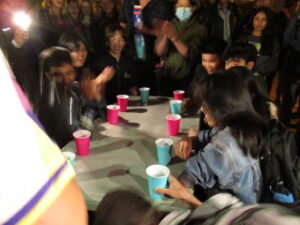
The ultimate, high-velocity optimization challenge of a Waterloo Engineering term does not take place in a lab, but rather along the long, green-felt tables of the faculty’s landmark celebrations. BOATs is a legendary, fiercely competitive team beer-chugging relay race that acts as the mechanical baseline for student life. This structural drinking ritual is divided into two distinct seasonal markers:
- BOT (Beginning of Term): The initial welcoming bash that kicks off the academic cycle. It serves as the preliminary staging ground where newly returned co-op cohorts and class groups assemble their fastest squads to run baseline qualifiers.
- EOT (End of Term): The grand finale of termly survival. As archived on Youtube like EOT Fall 2006, the final event is a wall of cheering and spray. Two opposing teams line up along opposite sides of a long, green-clothed table with precisely filled glasses. Upon a starting blast, the first engineers down their beers, aggressively slamming the empty glass flat onto the table to visually trigger the next teammate in line. The team that evacuates their combined liquid volume with the highest flow rate claims undisputed institutional bragging rights.
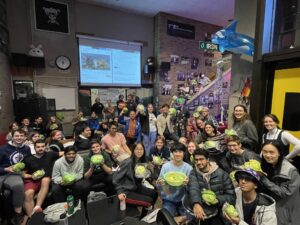
The Waterloo Lettuce Club
Rooted in absolute, chaotic simplicity, the Lettuce Club is a specialized, rapid-fire competitive eating event held once a term. Engineering students gather in a tense circle, each armed with a single, standard-sized head of iceberg lettuce and nothing else. Upon the sound of a starting horn, competitors frantically consume the raw leafy greens. The rules are absolute: no dressing, no seasoning and no structural cooking permitted. The first individual to completely clear their plate is crowned the “Lettuce King/Queen”, winning a cheap plastic crown and the immense responsibility of organizing the next term’s geometric lettuce procurement.
Post-Alumni Lore & Iron Ring Rituals
Iron Ring Stag (IRS) & The Countdown
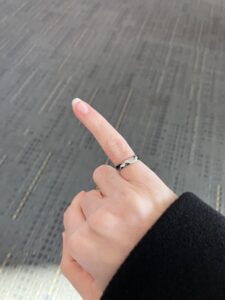
Worn on the pinky finger of the dominant hand since 1922, the Iron Ring is the Canadian symbol of professional obligation and engineering humility. The evening following the private ritual is IRS, a massive celebration enforcing an all-black dress code that marks the very first opportunity for graduating students to legally touch The Tool.
“HOW MANY DAYS ‘TILL IRS, FOURTH YEARS??!”
Conclusion
Of course, there are many other traditions in the society that I haven’t even covered. While this looks at only a handful of the customs that shape our community, our traditions are more than just repetitive rituals. They are the invisible threads that tie our past to our present and connect us to one another. There are countless other traditions woven into the fabric of our society, some grand and public, others quiet and confined. But whether widely practiced or deeply personal, each one serves as a reminder of who we are, where we came from, and what we choose to carry forward into the future.
References:
A peek at Disorientation Week. (2013, February 6). The Iron Warrior. https://iwarrior.uwaterloo.ca/2013/02/06/19924/a-peek-at-disorientation-week/
FYIC 2016. (2016, February 8). The Iron Warrior. https://iwarrior.uwaterloo.ca/2016/02/08/36213/fyic-2016/
Lasting longer than Liss Truce – Lettuce Club. (2024, March 26). The Iron Warrior. https://iwarrior.uwaterloo.ca/2024/03/26/51234/w24-lettuce-log/
PDF archives. (n.d.). The Iron Warrior. Retrieved June 28, 2026, from https://iwarrior.uwaterloo.ca/pdf-archives/
The history of Orientation Week at UWaterloo. (2016, September 6). The Iron Warrior. https://iwarrior.uwaterloo.ca/2016/09/06/38731/the-history-of-orientation-week-at-uwaterloo/
Traditions. (n.d.). Waterloo Engineering Society. Retrieved June 28, 2026, from https://www.engsoc.uwaterloo.ca/about-us/traditions/
Waterloo Engineering Society. (n.d.). Home [YouTube channel]. YouTube. Retrieved June 28, 2026, from https://www.youtube.com/UWEngsoc
Leave a Reply