



Whether you’re in engineering or not, students all over Canada and internationally know that the University of Waterloo is one of the top engineering schools in the country. Every year, about 13,000 students apply, while only about 1,900 students are accepted, making Waterloo Engineering’s acceptance rate between 5-15% depending on the program [1] [2]. This makes Waterloo one of the hardest universities to get into for engineering, and with that competition a specific culture comes about: prestigious jobs, high-paying positions, Big Tech. There’s a reason Waterloo has garnered nicknames such as Canada’s Silicon Valley or MIT of the North [3]. This article investigates Waterloo Engineering’s work culture and the way its students think. What came first, Waterloo Engineering’s highly competitive culture or Waterloo Engineering students’ internal pressure to succeed?
Part I: What do Waterloo Engineering students value most in their career?
This part of the survey investigates the values of Waterloo Engineering students. How do they think? What do they aim for?

Waterloo Engineers believe that having a prestigious job is something they aim for. But what does prestigious mean to them?
What is a “prestigious” job? What does the term “prestigious” mean to you?
(Note that there will be more than 31 tallies since some responses provided two different answers.)
| Response | Tallies | Frequency |
| Sought after/Recognizable/Respected (ex. Big Tech) | |||| |||| |||| ||| | 18 |
| Money | |||| |||| ||| | 13 |
| Social Impact/Meaningful | |||| | 5 |
| High Rank | ||| | 3 |
| Good Care of Employees/Employees learn a lot | ||| | 3 |
From these responses, it is clear that Waterloo Engineering students consider recognizable companies and high-paying positions as being indicators of a “prestigious job.”
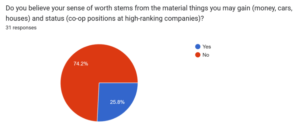
Despite striving for high-paying jobs and high-status positions, almost three quarters of Waterloo Engineering students believe their sense of worth does not stem from the material things they gain.
What is the most important trait of an engineer?
(Note that there will be more than 31 tallies since some responses provided two different answers.)
| Response | Tallies | Frequency |
| Problem Solving/Critical Thinking | |||| || | 7 |
| Resilience/Perseverance | |||| | 5 |
| lntegrity/Morality/Honesty | ||| | 3 |
| Adaptibility | ||| | 3 |
| Discipline | || | 2 |
| Accountability/Responsibility | || | 2 |
| Social Intelligence | || | 2 |
| Creativity/Open-Mindedness | || | 2 |
| Collaboration | || | 2 |
| Lifelong Learning/Relate Career to Life | || | 2 |
| Attention to Detail | | | 1 |
| Innovation | | | 1 |
| Intuition | | | 1 |
From the students’ responses, the most important trait of an engineer is problem-solving. In order to achieve high-paying positions in reputable companies, it is important to be able to solve problems effectively and efficiently.
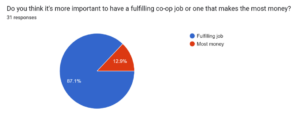
It is expected that since Waterloo Engineering students’ goals align with prestige, rank and money, they’d aim for working a job that makes the most money. However that is not true, it shows that over 80% of Waterloo Engineering students find it more important to work a fulfilling job.
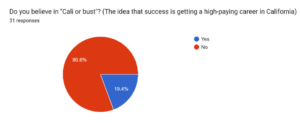
“Cali or bust” is a common concept in Waterloo Engineering. It measures success for Waterloo Engineering students by whether they secured a co-op position in California or not. You may feel this pressure with varying intensity depending on the program you are in. For example, Software Engineering has a very prevalent “Cali or Bust” notion, whereas programs like Chemical Engineering do not experience it much in comparison.
Part II: What pressures do Waterloo Engineering students feel to live up to those standards?
It’s clear that there are high standards among Waterloo Engineering students, and many may not be surprised by this. However, what pressures do Waterloo Engineering students feel to perform?

Over 80% of students said that their career success is tied to their self-worth. This mindset may have some benefits that allow students to reach their full potential. However, the downsides to this mentality are far greater. Career success can mean positive things, but, if it is directly tied to your perception of yourself, it will negatively impact your mental health. We are more than just creatures of work; what makes us unique is our art, our expressions, and our empathy. It is important to not lose ourselves in the pursuit of success. The careers we have will eventually leave us, what will stay is the positive change that we made in society.
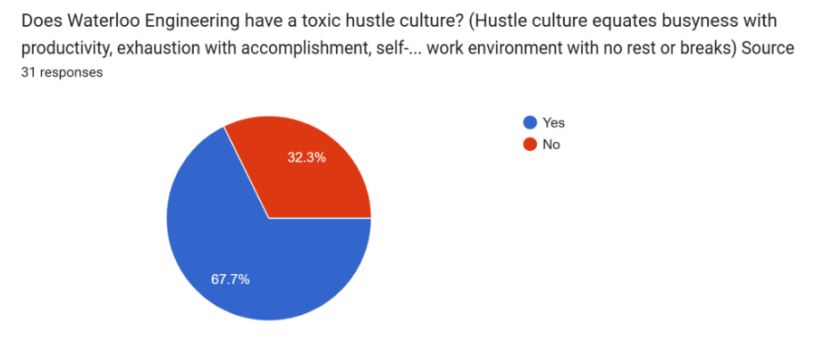
The source for the question below is referenced here [4].
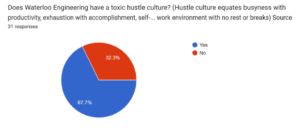
The majority vote shows that students believe that Waterloo Engineering has a toxic hustle culture. The idea of the hustle culture is similar to the saying “running the rat race.” In the 1930s, carnival and gambling attractions ran games where rats were placed in a maze seeking a reward at the end of it [5]. Over the years, the term became a metaphor for the unpleasant life of fierce competitive pursuit of wealth and power [6]. If most students believe that Waterloo Engineering has a toxic culture, something needs to change. However, I will highlight that almost a third of responses believe that Waterloo does not have a toxic hustle culture. This leads me to wonder: is Waterloo Engineering’s culture toxic? Or is it our own insecurities that lead us to believe the culture is toxic?
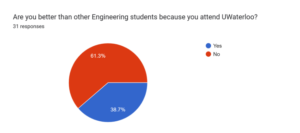
My intention with this question was to delve deeper into the Waterloo Engineering student’s mindset. Over 60% of students do not believe they are better than other Engineering students because they attend Waterloo, however over a third of students believe they are. This could be attributed to the highly competitive admissions process. Automatically, students believe they are better than others since they were accepted to a highly coveted engineering school. This ties back to the question about self-worth and career: does this mean that Waterloo Engineering students believe they are better because their measure of success is related to their career?
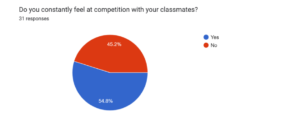
Over 50% constantly feel at competition with their classmates, with most students believing that Waterloo has a toxic hustle culture, this isn’t a surprise.
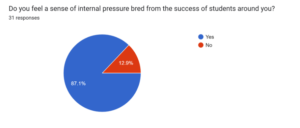
Most students feel pressure stemming from the success of those around them.
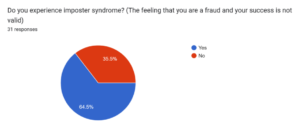
Most students experience imposter syndrome.
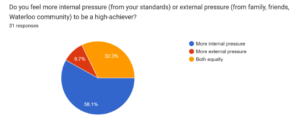
Waterloo Engineering students are high-achievers coming from high schools where they were likely the top of their class. Thus, it’s not surprising that they feel a mix of internal and external pressure. In high school, they may have measured their own level of success using the baseline of students around them. This measurement system is inherently flawed and shatters once they attend UWaterloo. When they enter Waterloo Engineering’s hub of talent, that baseline is raised and they struggle to grasp at their sense of self, leading to feelings of insecurity and internal pressure. External pressures may rise too, leading to stress.
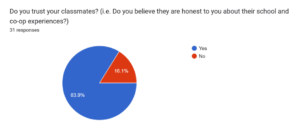
Nonetheless, Waterloo Engineering students have a culture of trust. Although they may feel at competition with their classmates they do not feel that their classmates are dishonest.
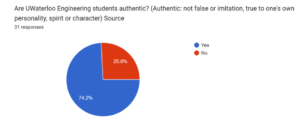
Similarly, they believe Waterloo Engineering students are authentic.
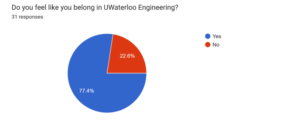
Waterloo Engineering students feel like they belong.
Part III: What would UWaterloo Engineering students do to achieve what they want?
The image of the Waterloo Engineer has been established: high-achieving, highly competitive, problem-solving and authentic. Now, what are they like in their pursuit of success?
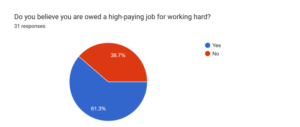
Most people believe that if they work hard, they are owed a high-paying job. Since Waterloo Engineering students are highly driven, it is not surprising. However, life is not always fair, and it is important to be kind to yourself when working on your career.
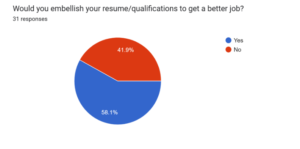
The wording of “better job” in this question makes it a bit tricky. In this economy, it is not surprising that students would embellish their resumes to get a job. However, getting a “better job” means that there is an option for just a job. Perhaps Waterloo Engineering students are somewhat opportunistic after all. I applaud the 41.9% that decide to remain honest.
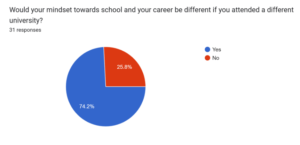
Almost three quarters of Waterloo Engineering students believe they would have a different mindset towards school and career if they attended a different university.
Conclusion
What came first, Waterloo Engineering’s highly competitive culture or Waterloo Engineering students’ internal pressure to succeed? I believe it may be more cyclical than that: Waterloo Engineering was founded on the concept of co-operative work terms, which were a huge success since they gave students ample experience before they graduated [7]. That led to a group of highly driven students to seek out the university. This led to Waterloo Engineering’s hustle culture, which attracted more students seeking success in their careers. This survey showed that there are negative work habits associated with Waterloo Engineering, but those habits can also be attributed to the competitive nature of the students that Waterloo attracts.
Ultimately, we should all remember to be kind–to ourselves and to others. What you believe is success may not be success to someone else. We should all promote an environment in Waterloo Engineering where all students can thrive and achieve their goals. Our careers do not define us as people, our actions do.
Leave a Reply