



The 3-3-3 Technique:
Each day, plan to…
- Spend at least 3 hours working on a major project. On school term, I treat my evening study block (usually working on the assignment due soonest) as my big task. Labs are also big tasks. On work terms, I block “work” off as one big task in my personal calendar. If you have some control over your schedule at work, you can often nest another 3-3-3 inside of it.
- Complete 3 “medium” tasks/events. These usually take about 30-120 minutes, and include things like meetings, lectures, interviews, going to the gym, meal prep, etc. When needed, you can combine 2-3 medium tasks into a second big task.
- Complete 3 “small” tasks that will make your life go smoother. These usually take less than 10 minutes and include things like taking out the garbage, responding to an email, cutting your nails, booking an appointment, etc.
As someone who constantly underestimates how long things will take, I find this framework really helps me set realistic expectations for how much I can do in one day. Framing the small tasks as “life-smootheners” and prioritizing just a few of them daily helps me stay on top of housekeeping, self-care, and administrative tasks.
Write it down
Keep a to-do list. It doesn’t matter what app you use or if you prefer pencil and paper, but make sure you have it with you throughout the day. Whenever you think of a task you need to do, write it down. That way, you don’t forget about it, and you will stop worrying about forgetting it. This is called cognitive offloading, and it frees up your attention for deep focus on the task at hand. (The Art of Stress-Free Productivity: David Allen at TEDxClaremontColleges, https://youtu.be/CHxhjDPKfbY?si=hy06e_ht4bS1pZLM)
Getting things done is all about the things you don’t do
Whenever you choose to do something, you are choosing not to spend that time on anything else. This is known as opportunity cost. In life, and especially in Waterloo Engineering, you need to prioritize. The most productive people are those that recognize which tasks are not worth doing, so they can focus on the ones that are. (The Art of Stress-Free Productivity: David Allen at TEDxClaremontColleges, https://youtu.be/CHxhjDPKfbY?si=hy06e_ht4bS1pZLM)
Treat Your Time as an Investment
Everyone knows the old adage “time is money,” but few people invest their time in the same way they do money. The key idea here is to invest your time in things that will save you time in the long run. Meal prep is a great example. Suppose it takes me 20 minutes to grate cheese, chop onions, peppers, and ham, and whisk eggs to make one omelet. Now, fried eggs don’t reheat very well, so I’m not going to cook a bunch of omelets ahead of time, but if it takes me 40 minutes to do enough prep for 5 omelets on Sunday, then I’ve paid off my investment in two days, and saved myself a whole hour between Wednesday and Friday! (How To Multiply Your Time | Rory Vaden | TEDxDouglasville, https://youtu.be/y2X7c9TUQJ8?si=XEMH34B3vc65mPM4)
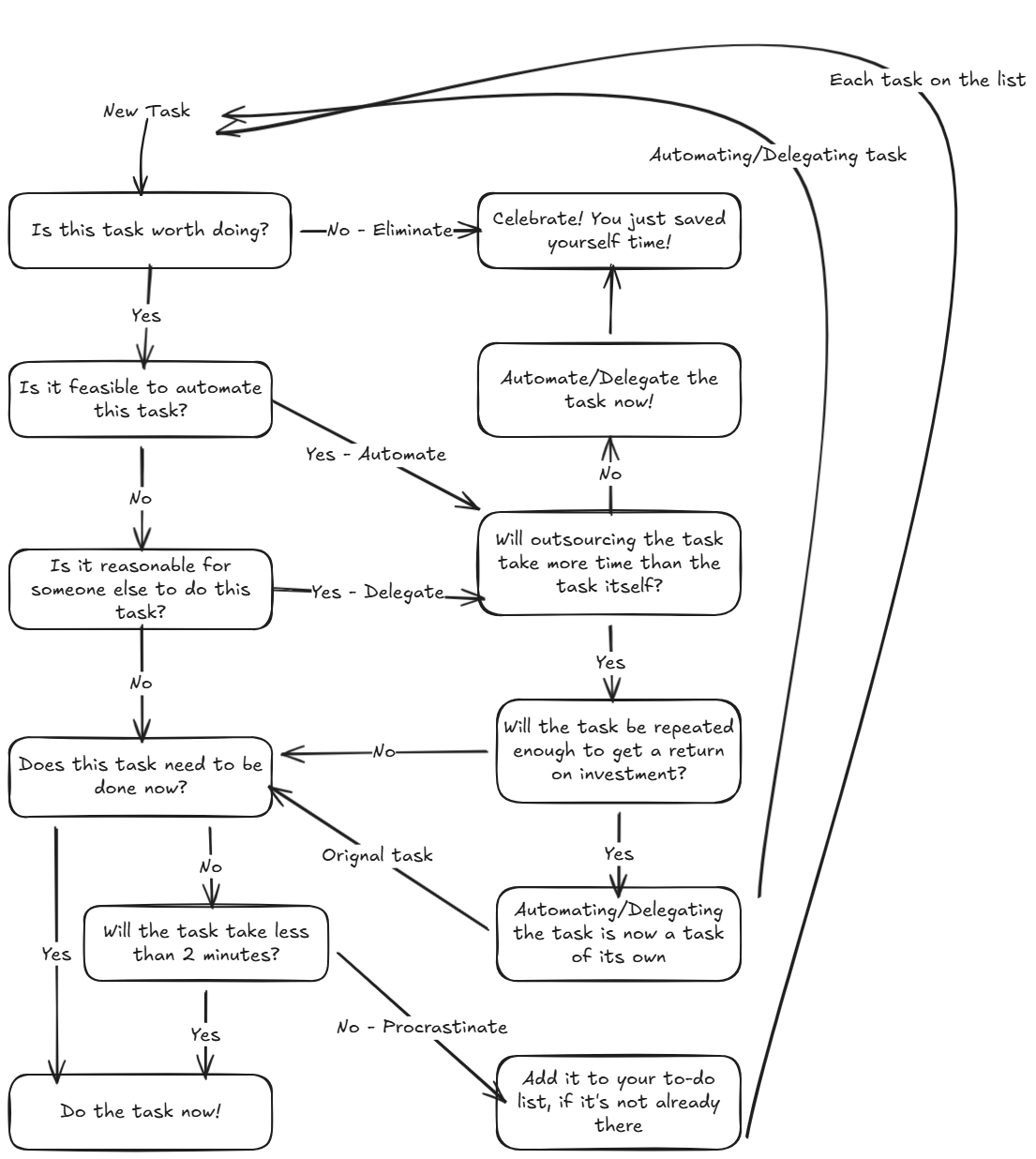
The funnel: Eliminate, Automate, Delegate, and Procrastinate
This diagram builds upon the work of Rory Vaden, explained in his 2015 TED Talk “How to Multiply Your Time.” I would highly recommend watching it to learn more. (https://youtu.be/y2X7c9TUQJ8?si=XEMH34B3vc65mPM4 for those reading online)
Time budgeting – Set limits
Building upon the “time is money” mindset, it is important to budget your time. More important things usually deserve more time than less important ones. Each week, especially during exams, figure out how many hours you have available for studying. Give yourself a realistic buffer for sleep, food, going to class, travel time, etc. Then do some math about how much time each assignment is worth:
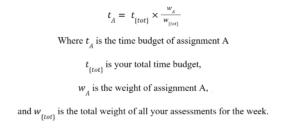
As you progress through the semester, you will learn which assignments take more time than they should and which ones take less time than they should. You can adjust your time budget accordingly.
When you sit down to work on the assignment, set a smaller time budget for each question, and set a timer for halfway through that time budget. If you’re stuck by the time the timer sounds, ask your peers or TAs for help, so you can use the rest of your time budget for that question efficiently. If you expend the whole budget for that question or assignment, it’s probably time to move on, even if it isn’t finished.
Call it done at 75%
Now, this one might be controversial. My personal academic goal is to maintain an average above 75 without failing a class or burning myself out. I am also someone who generally performs well on exams, as long as I study enough. If you have higher grade expectations, or if you have really bad test anxiety, this might not be super helpful for you. I encourage you to read on anyway, consider my advice, and take it or leave it as you see fit for your own life.
When I started university, I knew it was normal for your grades to drop. However, I thought that I would still do all the homework and assignments to the very best of my ability, and lose marks for genuine gaps in my understanding. I was prepared to accept that and learn from each of those mistakes, but I soon realized my expectations weren’t quite right. This depends on the workload and complexity of your courses, but I can only speak from my personal experience as a Software Engineering student. I found that I could usually tell when I was wrong, but not be sure what the right answer was. Worse was when I couldn’t even come up with a wrong answer! Even when I wasn’t exactly stuck, I found that it took me a long time to think through the assignments and complete them. This has cost me many hours of sleep over the years, and even when I start assignment A early, it takes me so long that I have to scramble to complete assignment B anyway. Then you get stuck in an endless cycle of starting late and finishing at the last minute.
What I have found extremely helpful is calling it done at 75%. Most instructors will tell you how much each question is worth on an assignment. When I have a lot due in one week, I choose which parts to do based on the point value, my confidence in the topic, and which ones I think I will learn the most from. When I have at least 75% of the points, I stop and move on to the next assignment. If time permits (being on-schedule with my other assignments), then I circle back to finish the first assignment and re-submit it. The way I see it, it’s better to get 75% in two assignments than to get 100% in one and 50% on the other.
Leave a Reply