
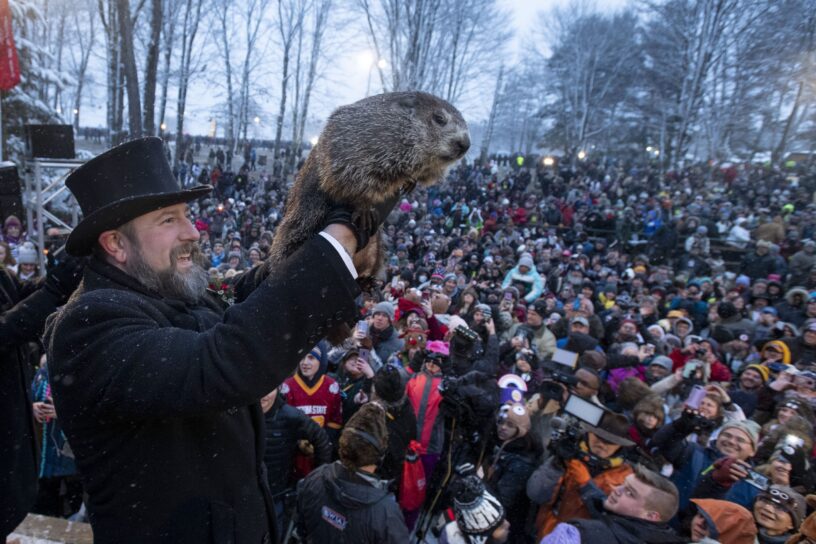



Something very hilarious was brought up during one of our meetings last month.
During the meeting we had on February 3rd, as I was wrapping up the layout for the first issue and we started to plan for this second one, we got a little sidetracked talking about Groundhog Day. Our Social Media Manager, Amara, brought up the news that one groundhog predicted an early spring, while another predicted a longer winter. Now, I know we’re in March and all, and this topic would’ve been more appropriate for the last issue… but I abandoned my article idea and decided writing about this would hopefully be more interesting, because as Amara kept digging into the results of this year’s Groundhog Day, she eventually blurted out something flabbergasting (for me): “Lucy the Lobster”.
I hope you’re probably thinking, like I was, “Wait… What?” Before I continue though, it would be good to make sure everyone is on the same page, which means it’s time for an info dump. Groundhog Day originally came from the Christian holiday Candlemas Day, when on February 2nd, Christians would take their candles to the church to have them blessed. Over time, the tradition evolved into one of weather prognostication, and when it was introduced in Germany, it further evolved into animal weather prognostication, as the Germans used hedgehogs to predict the extension of bad winter weather if the small mammals saw their shadow on Candlemas. When German settlers came to America, along with them came their tradition and folklore, but with the absence of hedgehogs in the new continent, they turned to groundhogs [1]. As you probably could figure, the folklore is partially based on hibernation: if they come out of hibernation in early February on a cloudy day, they’ll stay outside, indicating that the weather is improving and the worst of winter has passed, but if they see their shadow (i.e. the sun is out), it’s a sign it’s not yet spring and they’ve woken up from their sleep prematurely [2].
In the present day, Groundhog Day still works the same: on February 2nd, if a groundhog sees its shadow, we infer 6 more weeks of winter, but if it doesn’t, we infer the arrival of an early spring. Truthfully though, the groundhogs aren’t 100% accurate; data reveals they’ve been accurate around 37% of the time in the past 30-40 years [4]. Despite that, every year, there are still large gatherings of locals and tourists on Groundhog Day morning to watch the groundhogs’ prediction, notably those for Wiarton Willie in Wiarton, Ontario and for Punxsutawney Phil in Punxsutawney, Pennsylvania [3] [4].
Once Amara mentioned Lucy the Lobster, we were pretty much locked out. We eventually got back on track, but thanks to her curiosity, I got to discover 2 very interesting things:
- There isn’t just one groundhog, and
- It turns out that groundhogs aren’t the only thing used for Groundhog Day (my choice of the word thing rather than animal is very intentional, and you’ll understand why soon).
As Groundhog Day is a tradition that’s spread far throughout Canada and the US, many cities have a special groundhog or other animal for prognostication. A list can be found on https://groundhog-day.com/predictions/2026, but I’ll highlight some of the interesting non-groundhogs here [2]:
- Athene the burrowing owl, Florida (a burrowing owl mascot)
- Benny the Bass, Ohio (a largemouth bass; rather than using its shadow, Benny is fed minnows, and if he eats them under 3 minutes, it’s an early spring)
- Big Al, Texas (a 92-year old alligator; offered chicken breast, if he eats it, winter is over)
- Bee Cave Bob, Texas (An armadillo, part of the “Armadillo Day” movement, who also predicts the upcoming year’s partisan lean. Quoting Terry Booth, one of the movement’s founders: “We don’t need no mangy groundhog in Pennsylvania predicting the weather for us.”)
- Birmingham Jill, Alabama (the Birmingham Zoo opossum who takes over the groundhog role so the zoo’s groundhog doesn’t have to wake up early from hibernation)
- Concord Casimir, Ohio (a cat; fed perogies, if he eats them sloppily, it’ll a long, messy spring, if he eats them normally, it’s still winter, if he swallows them in one gulp, it’ll be a warm summer)
- Dover Doug, Pennsylvania (a groundhog mascot, who uses a special dance rather than its shadow)
- Featherstone the Flamingo, Massachusetts (a plastic flamingo lawn ornament, substitute to a groundhog as Leominster, MA’s mayor rants, perhaps as part of their tradition, “There is no street named after a rodent, I’ve looked this up. Rodents are yucky, they carry disease, there’s nothing fun about them.”)
- Lander Lil, Wyoming (a bronze statue of a prairie dog)
- Lucy the Lobster, Nova Scotia (the prognosticating lobster that incited me to write this article)
- Walnut the Hedgehog, Ohio (a hedgehog who supposedly got into prognostications after meeting the groundhog Phil…)
- Sylvia the Apex Armadillo, North Carolina (an armadillo who for her prognostication is raised towards the sky by the mayor while listening to The Circle of Life, then whispers her prediction to the mayor since he’s supposedly the only one who understands Armadillo-ese)
- St. Thomas Sally, Ontario (a colourful groundhog mural)
- Snack Town Steve, Pennsylvania (an almond snack-loving gray squirrel)
- Scramble the Duck, Connecticut (a Pekin duck, Eastford, CT’s “Duck Day” prognosticator who, according to his website, received weather prediction education at Stormy Heights Academy, graduating as Valedictorian in 2014, and also believing he is more connected to the weather than hedgehogs since he lives above ground year-round)
- Pisgah Piper, North Carolina (a white squirrel who also predicts the Super Bowl winner)
- Mojave Max, Nevada (a desert tortoise who brumates throughout winter and emerges in spring, his emergence being the indicator of spring’s arrival; Groundhog Day marks the start of a contest for elementary school students to guess his emergence date)
(NB: By mascot, I mean a person dressed up in a costume of the animal.)
I learned quite a lot of surprising facts doing research about Groundhog Day, and I hope you learned something new as well reading this article! I highly encourage you to read up on some of those animals and mascots (though you might be surprised to find out just how many of the groundhogs are actually taxidermied, mascots, or plushes…). Shoutout to Amara for the article inspiration!
References:
1. The Punxsutawney Groundhog Club. (2026). What is Groundhog Day? https://www.groundhog.org/groundhog-day/what-is-groundhog-day/
2. Groundhog-Day.com. (2026). https://groundhog-day.com/
3. Maria, C. (2026, February 2). Groundhog Day 2026: See the predictions here! The Weather Network. https://www.theweathernetwork.com/en/news/weather/forecasts/groundhog-day-2026
4. Bonikowsky, L. and Philips, D. (2011, November 20th) Groundhog Day in Canada, Encyclopedia Canada. Last Edited February 4th, 2022.
https://thecanadianencyclopedia.ca/en/article/groundhog-day
Leave a Reply