
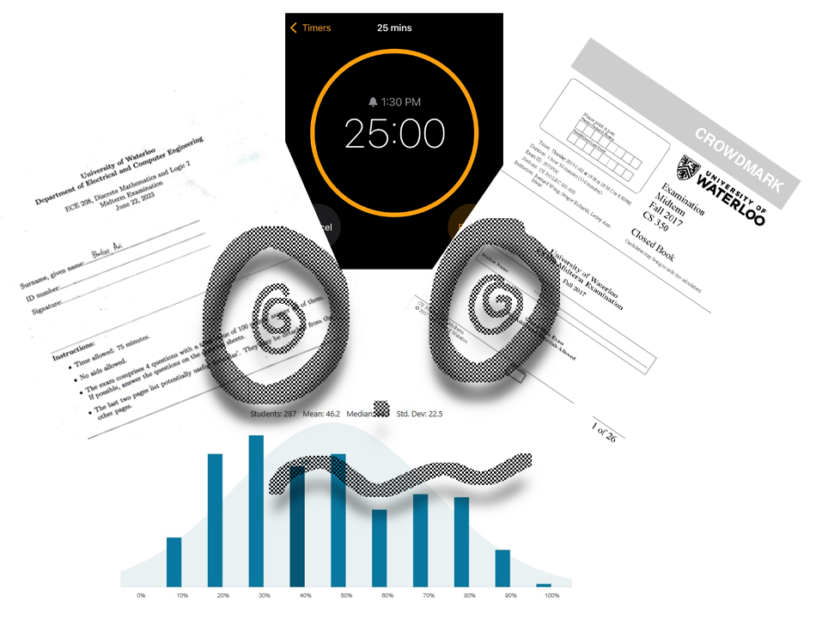



Testing is a pain. Nobody likes having (typically) the majority of their grade, the numerical manifestation of their academic success, determined by an arbitrary paper they are given a couple hours to complete. On the other hand, the school needs some way to assess whether a student has put in sufficient effort in their learning, otherwise it’d be little more than a diploma mill.
Final exams are born out of necessity, and are the most practical approach to testing a student. Everyone in a class gets the same exam, and grading can be done quickly and fairly objectively, at least compared to alternative approaches. The amount of content in the exam is within a certain range, as it must be completable within a time limit. This is to the benefit of students, as the typical exam is designed to be completable with significant time to spare. The system is also flexible; the professor can prioritize broadly testing main ideas from every week, or ask deep questions from random topics. Some exams may prove too difficult, but curving allows for this to be compensated for after the fact.
There are also improvements in overall learning from this method. Final exams are designed to encourage students to review their courses weekly. Spaced repetition is shown to be one of the best ways of absorbing information in the long term, as any user of Duolingo or Anki could tell you.
The main alternative to the final exam in engineering, mostly found in upper year courses, is the final project. Critics of exams may argue that the workload at the end of the term is too high and that exams make for a poor way to assess learning. After all, students can memorize their way through, or simply get unlucky when the questions on the exam don’t align with what they studied. However, the issues that exist with exams aren’t nearly as bad as the problems with its main alternative!
You can write a test for any course, because there are many types of questions that can be asked in a test. The possible scope of projects a student can be expected to create given the content in a course is much, much tinier. Often, this means final projects depend on knowledge that was not well covered in lectures. To compensate, students are usually given the project earlier in the term, but this time is almost always squandered because there is always a more immediate deadline. Unlike an exam that is designed to be taken in a few hours, a project can take a completely unknown amount of time. Typically this means a big cram at the end, with prayers that the project topic is a part of the course that was well taught. A student can walk into an exam having partially studied the content and receive partial marks – a partially completed project is worth nothing.
Given the greater difficulty in marking a project compared to an exam (programming courses excluded), these are often group endeavors. Group projects are a nightmare: almost always, some students (those desperate to do well) must carry those that just care about passing. This is terrible for judging performance, as now the student’s grade also depends on their ability to find hard working classmates. Working in a group also blows up any chance of starting the project early, as everyone always has other commitments. At the very least, some great friendships have also formed through the tried and true last day project grind.
All in all, final exams have their issues, but reign supreme because they are the easiest to implement and most versatile way to test students. Though there are ways to execute on them better, it’d be better to stick to them than to try and give students more projects at the end.
Leave a Reply