


What if I told you that you already finished reading this article?
In this article, I’ll be discussing the theories that were introduced in a Kurzgesagt – In a Nutshell video. The video is titled “Did The Future Already Happen? – The Paradox of Time.” I highly recommend watching that video as it touches on many complex physics topics in a simplified way. The studio, Kurzgesagt, releases entertaining, simple science videos that introduce confusing concepts in an easy-to-digest format.
The past, present and future have always been understood as three distinct entities: you were born in the past, you live in the present and you will die in the future. However, with modern physics, things take a different turn.
In 1916, Albert Einstein published the General Theory of Relativity. This theory was preceded by the Special Theory of Relativity which he published in 1905. In the Special Theory of Relativity, Einstein establishes a concept called “space-time” an idea that weaves the three dimensions of space with time. This idea was completely foreign at the time, but over the next decade, Einstein worked to incorporate gravity into his theory, and this ultimately resulted in the General Theory of Relativity [2]. Simply put, massive objects cause the space-time fabric to stretch, which causes a dent in space-time and allows smaller objects to be attracted to larger objects [3]. But how does this relate to the past, present and future?
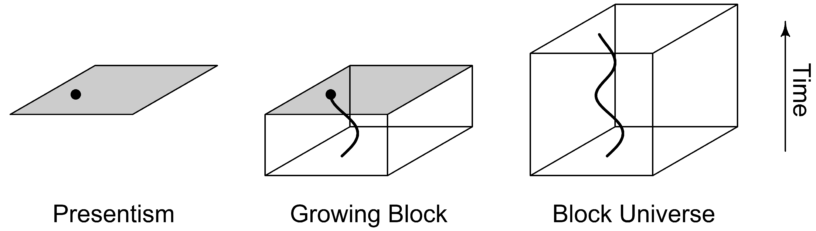
In Kurzgesagt’s video, a helpful image is shown, a cube representing space-time. If space is the XY-plane and time is the Z-axis, you get a cube representing the universe. This is where the idea of relativity comes in. If you are moving through space, according to the theory, you are moving through time as well. This means that if someone is moving through space differently relative to you, then they are also moving through time differently relative to you. This introduces the idea of “your now” [1].
Andreas Albrecht, a theoretical cosmologist at the University of California, Davis, says, “When you try to discuss time in the context of the universe, you need the simple idea that you isolate part of the universe and call it your clock, and time evolution is only about the relationship between some parts of the universe and that thing you called your clock.” [4]. You are experiencing time differently than someone on the International Space Station, so does that mean that another person’s “now” is invalid? No. This is the basis of cosmic democracy. Every observer’s point of view is equally as valid in the universe. The example given in the video is quite helpful. Three alien spaceships moving at different speeds either away or towards you would theoretically contact the version of you from the past, the present and the future. This implies that, as the video says “things don’t happen in the universe, the universe just is.” That is the theory of the Block Universe, a theory backed up by the General Theory of Relativity. This means that all the events in the universe are already pre-determined and written [1].
However, quantum physics tells us a different story. Radioactive atoms are described to be inherently random. They could decay at any instant without any way of knowing when. Scientists can only predict when the decay might occur, but no one knows for certain. This poses an issue for the Block Universe theory. Since these atoms make up life, they could change or mutate a living organism such that in a hundred years it will be a completely different species. This means that things might not be truly certain and the future is not already written [1].
This introduces the theory of the Growing Block Universe. Instead of the Block including the past, present and future, it instead only encompasses the past and present, where the present is not a flat, thin plane on the surface of the block, but instead an uneven surface that slowly rises as things occur and become certain. This surface is uneven because it contains all of the different perspectives of “now” of which are all equally valid [1].
Are you confused yet? Because I sure am. The Block Universe and Growing Block Universe theories have roots in physics as well as in philosophy, and since these theories are quite difficult to prove, many continue to believe in their own concepts of time. I know what I believe in, so what do you believe? Is the Block Universe the ideal theory, or is the Growing Block Universe better? Maybe a completely different theory is what makes sense to you. Oh, you don’t know what I’m talking about? Oh, how could I forget? You haven’t even read this article yet!
References
[1] Kurzgesagt – In a Nutshell. Did The Future Already Happen? – The Paradox of Time. (Jan 30, 2024). Accessed: Jun. 20, 2025. [Online video]. Available: https://youtu.be/wwSzpaTHyS8
[2] “Albert Einstein – Biographical,” NobelPrize.org, https://www.nobelprize.org/prizes/physics/1921/einstein/biographical/ (accessed Jun. 20, 2025).
[3] B. Mattson, “100 years of general relativity,” NASA, https://asd.gsfc.nasa.gov/blueshift/index.php/2015/11/25/100-years-of-general-relativity/ (accessed Jun. 20, 2025).
[4] R. L. Kuhn, “The illusion of time: What’s real?,” Space, https://www.space.com/29859-the-illusion-of-time.html (accessed Jun. 20, 2025).
Leave a Reply