
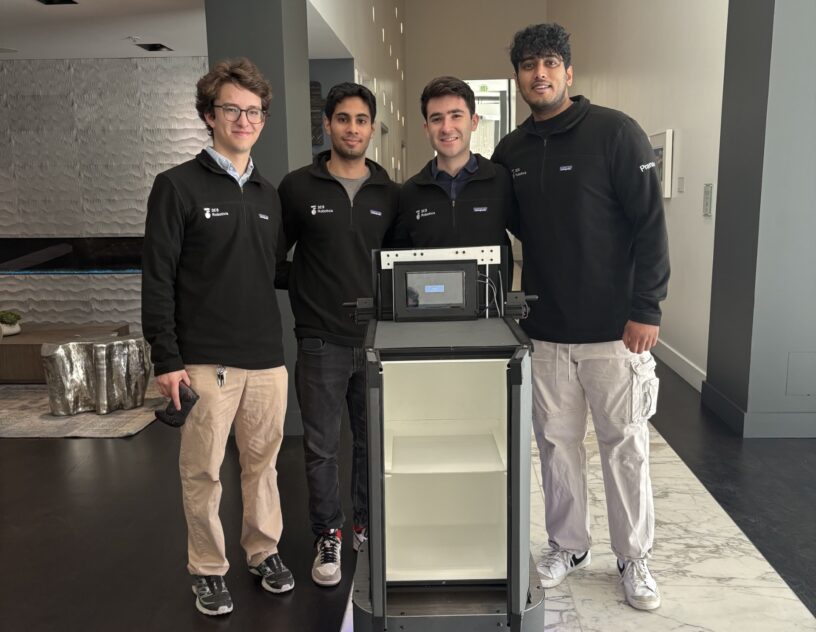


The University of Waterloo’s Faculty of Engineering has been a hub of growth for many decades. In 1958, the faculty opened its doors for students, and Waterloo Engineering became the first co-op oriented school [2]. Since then, the faculty has established itself as an entrepreneurial powerhouse, placing pride in its core values of excellence, entrepreneurship, and innovation [1]. David Feldt is a recent Waterloo alum (MTE ‘24). He founded 3e8 Robotics, alongside Ari Wasch (CE ‘25), Sajeel Purewal (Queen’s Commerce) and Pranav Seelam. He had a vision for what type of world he wanted to live in, and he worked to make that vision come true. I interviewed David and Sajeel, here is what they told me:
Q: Tell us a little bit about yourself, what your company is, and what inspired you to start your company.
David: For us, we were building stuff on the side and we really saw the opportunity to make something big. And you hear stories of people who go to California and are able to take an idea and make it something that changed the world. And I think that was pretty inspiring.
Sajeel: When we were toying with the idea, we were both working full time for about a year. So I graduated from Queens, I studied commerce, I worked in banking for about a year, and then when David came out [with the idea], we had gotten into the Founders, Inc offseason program. It was David, myself, and then our other co-founder Ari. That’s when we took the leap of faith. Then, six weeks went by and they decided to fund us, and that’s how we became a portfolio company and we’ve been working out of there.
Q: How did you guys meet and how did you decide to start this endeavour?
David: Both Sajeel and I were pretty close friends in high school, and we always toyed with the idea of building a startup together. We always had it in the back of our minds. For me, during university, I was building a bunch of projects. There was this one project that I was building; it was this event discovery app that pretty much rates all the events, it makes it easier to find them in the city. I started building it out, and I started launching it and it started getting a lot of attention. I realized I wanted some help on this. And I talked to Sajeel about it and I said, “Let’s just do this, it’d be fun.” And he agreed. This was actually the same time that we met Ari, our other co-founder. The way we met him is he was doing the same project as me, but on his own agenda. So we kind of merged it all together, like that.
Sajeel: We were doing that [app] for about six months and we realized that there was a huge potential in robotics. With advancements coming out, it’s something that we saw as existing in the future, and I think our team was kind of positioned to solve it. That’s why we went the robotics route, and initially when we were looking at what problem to solve in robotics, we thought the best thing would be cleaning. The market’s there and people gravitate towards that. Then we started talking with property managers, and one thing that they mentioned is the amount of deliveries that they do and how that takes up a significant portion of their time. We did some research and typically, you need elevator APIs, so what we’re doing, it’s just plug and play autonomy. You can put it in a building and it starts to work. That’s the North Star vision.
Q: How did attending the University of Waterloo help achieve your dreams of starting this company?
David: When I was first selecting universities, I wanted to pick one that was going to help excel me, put me to the top. And I think with Waterloo, it definitely did that. Like, you have friends that are working at all sorts of companies, you get all sorts of opportunities, you learn all sorts of technologies that are always cutting edge. I think that going to Waterloo, [it] is the absolute best university in Canada. And it’s funny when you come to the U.S., so many people know Waterloo, because all the kids work in the Bay. So all the up-to-date tech, engineering, talent, and resources are there, I would say. You just need to have a few conversations and you’ll learn about the newest tech stacks and robotics. I’ve seen cool projects and it’s really inspiring being around a community of people that are really pushing limits.
Q: What is one skill that you built specifically at Waterloo that helped you succeed in what you’re doing right now?
David: It sounds very simple, but it’s actually quite complex: how to approach a problem. Approaching a problem is the biggest misconception of engineering as a whole. You learn that there’s a lot of different ways you can solve it. So making the right decision of how you initially start to solve a problem is actually the most critical step. You can make a decision right at the beginning and you’re completely wrong, and you waste a bunch of time. And I think that skill is universal across startups, working in industry, and even on a personal level.
Q: What hopes do you have in terms of expanding your careers? What goals do you have for your company in the future?
David: I’d say my vision for the company is that I want to make robotics mainstream in terms of seeing robots doing things. I think one of the inspirations with our robot is that I’ve never seen a robot in a multi-floor building, and so it would be cool to have robots in those environments. There’s also other use cases where I can see robots being [helpful], especially in operations of buildings and outdoor settings, and making it so that there’s a lot of automation. I think it’d be cool to have this world where there’s these robots that are all working, but because they’re robots, they’re fairly cheap. You create this whole new pie in the economy where it’s cheaper to live because you have all this labour, so people can get higher paying jobs and it’s more valuable to be a human rather than to be a robot, that sort of thing. That’s what I look forward to, to make the world a better place and to create an industrial revolution, but for robots. I wish to be a driving force in that.
Sajeel: To add to that, people that aren’t necessarily in the robotic space, they often think it’s something that’s years out, and they often think that it’s something that’s very complex, it’s gimmicky, it only works in warehouses and manufacturing. But the truth is, I think over the next five to ten years, we are [going to] see a huge rise of service robotics in North America, and so long-term what we’re thinking is, how do we change people to think about adopting robots in their workplace, and how do we make a world where humans interact with robots and robots interact with humans? So I think that’s on a high skill level.
Q: What are some challenges you experienced in founding the company and challenges you still face now?
David: There’s technical challenges to getting the robot actually working. And then there’s the financial challenges of raising money. There’s also the business challenges of getting people interested in it. And they all circle on each other; the better engineering you have, it’s easier to sell something, and then it’s easier to raise more money and that sort of thing. So the challenge is deciding where you want to put your efforts. For me, as the CEO, I have to decide if I want to put my efforts on making the product better, or if I want to focus on doing more outreach or more funding. And it’s deciding where you want to start in this circle. I would also say a big technical challenge when you develop robotics in North America is supply. There’s designs that you can come up with that are really great, but it’s impossible to manufacture cheaply in North America. So that poses lots of challenges where you have to be a little bit more creative.
Sajeel: When you’re doing hardware, you have to pick your battles. There’s many dependencies on many levels on the tech side, but then operationally as well. For example, getting into a building, doing a deployment, letting a building of 300 residents know this is coming, and how they’re going to respond to it. So from that aspect, it’s making sure that all those dependencies flow together, and that [the] timeline lines up with the prototype being ready. Then when we’re ready to go do demos, [we think] how those demos are going to lead to paid pilots, kind of having that flow and having all of that planning done.
Q: What is one “hurray” moment that you had, where you felt like something really paid off or something finally worked that wasn’t clicking for a while?
David: We had one robot, which was our first one, we called it a V0, but that was the real prototype. Then we had our V1, which we would call our MVP. And that one we designed it from scratch. It was made fast, but it was done robustly, and the best we could. And I was really nervous because it had a lot of components that needed to work together. Especially when we finally assembled it, we put all the casing on it, put all the stuff on it, and we had demos coming up the next few days. I was working late nights with our other co-founder Ari. We assembled it. Then I remember when he booted it to drive, it worked, and there were no wire issues or anything. I didn’t have to take it apart, that was a big relief. I think that was a big win, I would say.
Sajeel: For me, I’d say when we signed our first pilot agreement with a condo building. So in March, we have a paid pilot coming up with Rockwell Condos. It’s a 300 unit building, there’s 12 stories. Part of the reason why it’s such a big hurray moment is in robotics, the sale cycles are quite long, so when you have that validation of knowing that someone wants what you have built in their building and that they see real value in it, that they’re willing to pay for it, that’s when it feels like this could work. When they signed it, it was a happy moment.
Q: What is something that you live by?
David: For me, I always ask myself, “Is it possible for me to do better?” And if it is, I should do it. I try to prove it, prove that I have to do better. It fuels me to always try and keep pushing myself. You learn more skills, you get better at things, and you don’t let any of the negative self-talk affect you.
Sajeel: There is a saying, “pushing paper walls.” People will have self-imposed limitations, like a paper wall there stopping something, and you don’t actually know it’s not doable or attainable until you go up there and you touch that paper wall and it collapses. When you’re young and you’re in your 20s, you should prioritize impact. You should put yourself in rooms where you think you can have the most impact, and you should take a lot of risks when you’re younger, and I think that’s something the whole founding team believes.
Q: Do you think that choosing a different program to pursue for your undergrad or taking different courses would have helped set you up better for what you are doing now?
David: I was doing firmware engineering before I started doing this, and I think, realistically, if I wanted to be like an industry kid, I could have done computer engineering, and I think I would have been more prepared. I feel like I had to learn a lot of programming myself, so I think it would have made more sense [for] me to be computer engineering. But that being said, with mechatronics I learned a lot more stuff and by the time I got to fourth year, I think I really got the value. Tron has the best ability to choose any courses out of any discipline. You can pick mechanical, electrical, or systems; you can pick all sorts of courses. So by fourth [year], I got to pick really cool courses, and I got to learn a lot about AI systems. I think that’s where I got all my value from. Waterloo, although it’s hard, it’s definitely the best program by a mile and it really starts to show, especially later in the years when you’re getting your later co-ops.
Sajeel: When you’re a student, you should optimize for where your passions are. Looking back, I wish I had taken technical courses and maybe done a double degree. But I think coming from having studied finance and working in banking, the one thing commerce does teach you really well is how to get your point across and communicate well with senior decision makers. Banking is one of those industries where it is very hierarchical, so being able to portray a narrative that they [as senior managers] can understand at a high level is important.
Q: What advice do you have for students looking to start a company?
David: Try and fail. I think that’s the best advice that I have received. You think that you can create a perfect company, that it has to be perfect the entire way, but from what I’ve learned, if you can fail correctly and you keep failing, you’re going to succeed. It’s just a numbers game where it’s like, try this design, doesn’t work, go to the next design, and if you keep failing, like, if you make every possible design that’s wrong, eventually you’re going to find the design that’s right. And I think when you try to just start, and just try and fail, you’ll end up in the right place.
Sajeel: Pick a problem that you’re passionate about, that drives you, because with starting a company there’s a lot of uncertainty at times, and you kind of need to have the conviction of, “this is what the world should look like, and this is why I’m working on this.” Even when times get tough, having that internal passion for what you’re doing is a big driving force, and part of the reason why so many founders that are successful are successful; because they stick with it long enough, not necessarily because they found this magic or because they got extremely lucky.
Q: Any final words you’d like to add?
David: The one thing I would say is regardless if you’re doing engineering, you should just always be building. I think that was a regret of mine. Just always build, even if it’s something small and simple. It’s a good muscle to train because with the course work, it’s very theoretical. I think with exercising your creativity, it’s good to just build.
Sajeel: I echo that. If you’re a student, explore where you’re curious, find what you’re passionate about, and stick to a problem that feels true to you.
Thank you so much to David and Sajeel for their time, and all the best for the future of 3e8 Robotics! If you are interested in learning more about David and Sajeel’s story, alongside their co-founders, feel free to check out these links below:
Website: https://www.3e8robotics.com/
Launch post: https://x.com/ariwasch/status/1976805215832883454
Founders Inc portfolio: https://f.inc/portfolio/3e8-robotics/
If you are a student or alum who would like to be featured in The Iron Warrior, reach out to us at theironwarrior@gmail.com!
References:
[1] “Home: Engineering strategic plan,” Home | Engineering Strategic Plan | University of Waterloo, https://uwaterloo.ca/engineering-strategic-plan (accessed Jan. 25, 2026).
[2] “Our history: Engineering: University of Waterloo,” Engineering | University of Waterloo, https://uwaterloo.ca/engineering/about/our-history (accessed Jan. 25, 2026).
Leave a Reply